How to choose the right project management tool for your business
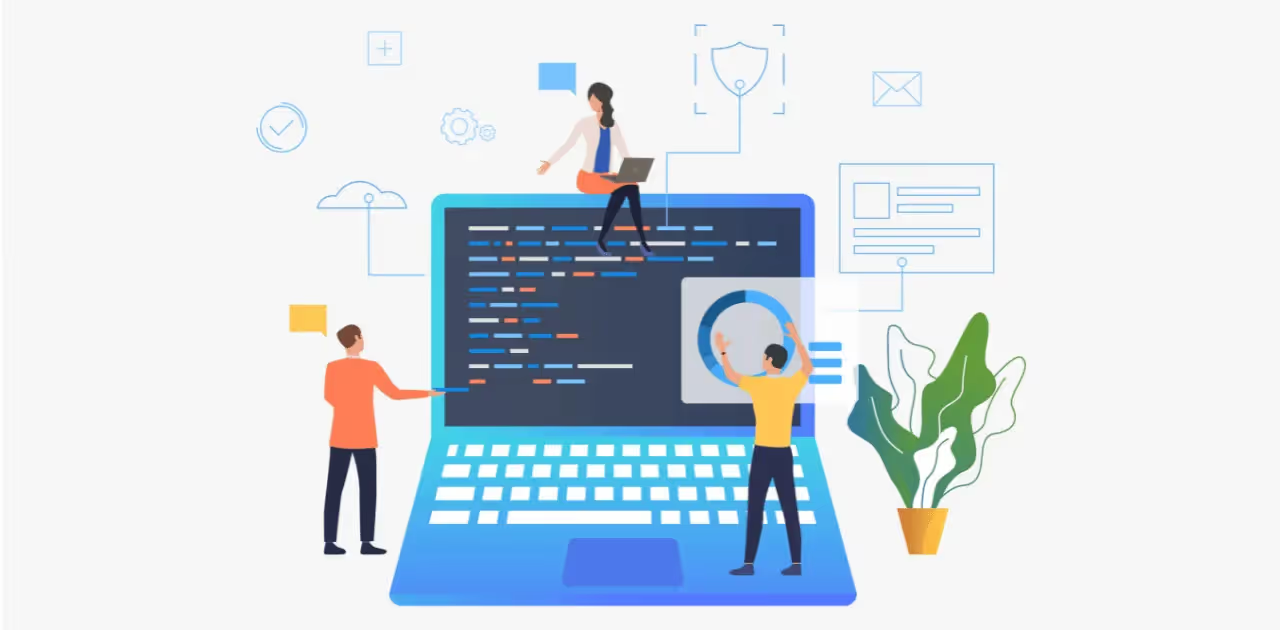
You would like to improve collaboration and productivity within your company, and for that, you decided to opt for project management software such as Wimi. This is a great idea because this type of tool offers a lot of advantages to teams. In particular, it makes it possible to coordinate the implementation of a project, to distribute tasks and to monitor their progress, or to facilitate communication and exchanges between team members, especially if they work remotely.
However, there are a multitude of project management solutions on the market right now, and it can be difficult to find the one that best fits your organization. Here are some tips to help you make your choice.
Reminder: what is a project management tool?
Managing a project from A to Z can be a real challenge for the project manager and his team.. To ensure the success of the project, it is essential to use appropriate tools that allow you to plan the project, monitor the budget and deadlines, but also to facilitate collaboration and communication within the team.
One project management software is, as its name suggests, a software that helps you effectively manage projects of all types and sizes. To do this, it has multiple functionalities essential to project management such as:
- one task manager and of resources;
- Of shared calendars;
- a Gantt chart;
- one space for sharing documents;
- a system of notifications and alerts;
- a reporting tool;
- communication tools.
In short, a project management solution is an all-in-one tool that simplifies project management and makes you more effective on a daily basis.
6 tips for choosing the right project management tool
Follow these tips to find the right project management software for your organization.
Define your needs
To begin with, it is important to identify your needs, in particular by listing the problems you must face, such as lack of visibility or the repetition of mistakes. Then determine the functionalities you need to be efficient in managing your projects. For example, a task manager to know who is doing what and to monitor the progress of each task; a document sharing space to centralize your files and find them more easily; or even, communication tools such as a instant messaging or a videoconferencing system to facilitate exchanges and collaboration.
Thinking about mobility
Since the pandemic, ways of working have changed and teams no longer work the same way. Within the same team, some employees can come to the office every day, while others are teleworking several days a week/month, still others may be on the go regularly and a fourth category of employees can work remotely on a permanent basis.
Hence the need to opt for a mobile solution, that is to say a tool that your employees can use everywhere, at any time, regardless of where they are. This means that your project management software should Have a mobile application and that your employees can use it from any device (smartphone, tablet or computer), or even offline, if necessary.
Don't overlook safety
Data leak or falsification, intrusion, password theft, etc., your project management tool must absolutely be secure in order to protect your data, whether it is the financial and strategic data of the company or the personal data of your employees and customers. Moreover, this must be valid for all your digital tools.
To do this, opt for a sovereign tool, that is to say French or European, which guarantees that your data is hosted in France or in Europe in order to avoid being subject to Cloud Act.
Also, check that the software offers privacy and security measures such as end-to-end encryption and multi-factor authentication, such as Wimi Armoured.
Finally, you should be able to easily manage access rights in order to determine who can access which document (s) and whether the person can only view the file read-only, edit, and/or share it.
Ask for the opinion of employees
Your employees will be the main users of the project management software. It is therefore logical that they should have a say in the choice of tool. To gather the needs and requirements of your employees, you can set up a survey. Ask them how they come up with the ideal software, what are the essential functionalities, etc.
In addition, your employees will appreciate the fact of being asked to choose a new tool. This will make it easier for them to adhere to the new tool, even if there will always be people who are reluctant to change. It's up to you to reassure them and convince them, in particular by setting up a change management.
Compare prices
Choosing a project management tool also depends heavily on your budget. First of all, know that you can choose to pay a monthly or annual package (the latter being more advantageous).
Next, you need to make sure that maintenance, updates, help, support, and various resources are included in the price listed, to avoid unpleasant surprises, especially if you have a problem or need technical assistance.
Finally, find out because software publishers offer reduced rates for certain types of organizations such as associations, NGOs or even public structures.
Do not hesitate to test
Once you have pre-selected two or three project management software that you like, do not hesitate to test them before making your decision. In fact, almost all software publishers offer between two weeks and one month of a free trial. This is the ideal opportunity to discover the tool, to see if your employees find it easy to use, if it has all the functionalities you need and if it perfectly meets your expectations.
Whatever you choose, opt for a simple and intuitive solution that will require little or no training. The objective is for your employees to be immediately operational and that they want to use this new tool on a daily basis.