Buying project management software: 5 mistakes to avoid

Today, more and more businesses are using software solutions on a daily basis. Collaborative platform, instant messaging, customer relationship management (CRM) software, customer relationship management software (CRM), analytical tools, data management, project management software, etc., these various tools and applications have become essential to simplify and automate employee tasks as well as to make the company more efficient and competitive.
You decided to acquire a project management solution for the multiple advantages it offers: monitoring the evolution of your projects, task management, centralization and sharing of data, collaboration and facilitated exchanges between team members, etc.
To help you make the right choice, here are 5 mistakes you may make when buying a project management software and the solutions to avoid them.
1. Not having a specific goal
Some businesses opt for project management software because this type of tool is trendy and a large number of businesses already use one. But is that a valid reason to invest money, time, and resources in a tool that you may not really need?
While it's obvious that project management software is useful and helps improve your productivity, the question to ask yourself is: why (s) do you want to acquire a project management solution? What problem (s) will it allow you to solve?
Without a specific objective, you risk buying inappropriate project management software that will not meet your needs and that will not provide you with added value in the long term.
The solution
The objective of this type of tool is to allow you to be more effective and to eliminate the blocking points within your organization. You must therefore identify these blocking points with the employees of the various departments of your company. This will allow you to define the essential characteristics and functionalities that your future tool should have.
2. Underestimating the time and cost of implementation
In addition to the purchase price, which can be high, the acquisition and implementation of classic software, known as “on-premise” (“on site” in French) within all company departments can take time. Indeed, the software must be installed on all servers or computers in your company, which mobilizes your team of full-time computer scientists. Not to mention staff training on the new tool, data migration, testing, etc.
In addition, the cost of purchasing a software license for a large number of employees can represent a significant financial investment, which should not be overlooked.
The solution
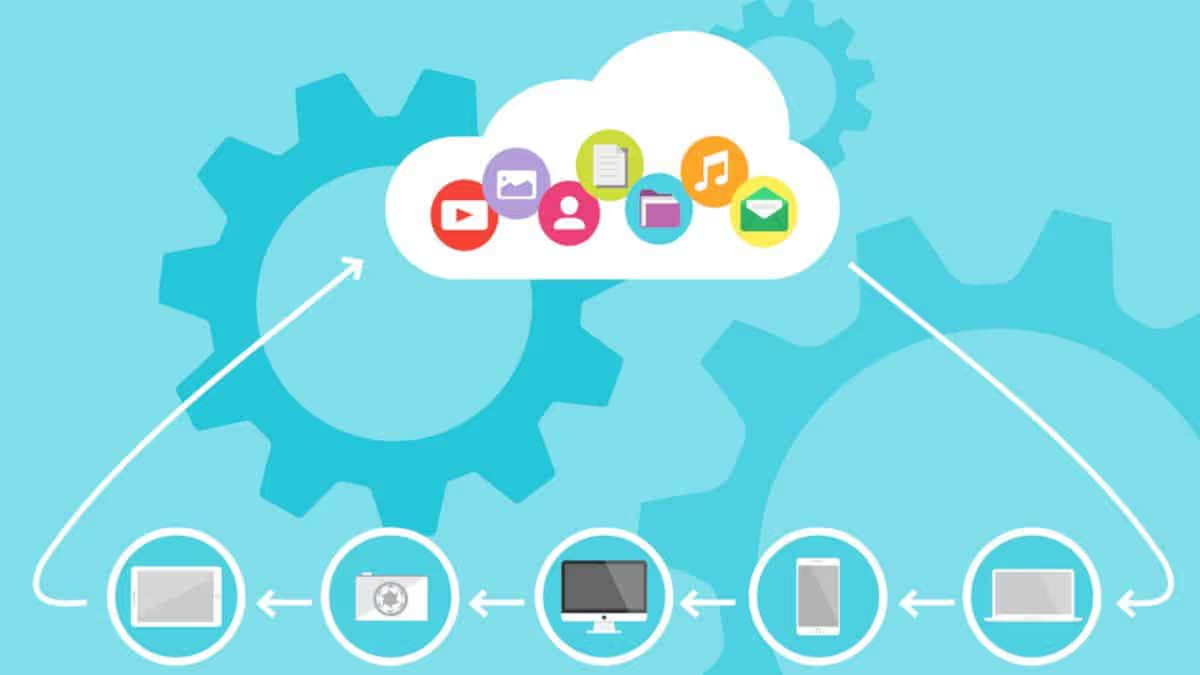
To save time and spend less, you can opt for SaaS (Software as a Service) software, in other words the software is relocated to the Cloud. All you need to do is subscribe to a monthly subscription from the publisher or host to be able to use it from any device connected to the Internet.
Need help choosing? Discover the pros and cons of SaaS and on-premise software.
3. Not taking into account the future needs of your organization
Today, you are looking for project management software to improve your productivity and performance, meet your current needs, and obtain immediate results in order to continue growing your business.
However, your current needs can change rapidly. If you do not anticipate these new needs, you may be forced to acquire new software that meets your new requirements or to subscribe to extensions, which can be more expensive than if you anticipated it when you purchased the software.
The solution
When acquiring your software, it is imperative to take into account your short and long-term needs as much as possible. While it can be difficult to predict the future of your business, you can make estimates of the number of employees and customers you will have in the years to come based on the current success of your business. This allows you to think about the different features and options to include, and to ensure that you can still use the same software for several years.
4. Do not take advantage of the trial period
Today, the majority of publishers offer you to test their project management software for free for a period ranging from two weeks to a month (or even longer). It would be a shame not to take advantage of it.
In addition to finding the best tool for your business, this testing period is a way to get your employees used to using software to do their daily tasks. If they are reluctant during the test phase, they are also likely to be reluctant during its implementation.
The solution
It is your employees who will decide if the software perfectly meets their needs and requirements, which is why they must test it.
Encourage your employees to use this new tool on a daily basis and to test all the functionalities. Then, ask them to give you feedback on their experience, and to note the ease of use and handling, the different functionalities, support, etc. If you are testing several software, do not hesitate to make tables Comparatives that will help you make your choice.
In addition, by encouraging your employees to make the most of the trial period, they will be in a position to use the chosen software effectively from the start.
5. Choosing software that does not have a mobile application
Today, between mobile teams, geographically dispersed teams and hybrid teams, few employees work only from their desktop computers, within company premises.
It then becomes essential to acquire tools that can be used from any device (computer, tablet, smartphone), regardless of where you are. Otherwise, it may hamper your team's productivity and performance.
The solution
Opt for a project management software that has its mobile application so that your employees can work on their project, exchange with colleagues or share a document at any time, even when they are away from the office.
Get started and test for free Wimi for 14 days without commitment.