Wimi-Ipsos study Open Work — Telework — Public VS Private

The Wimi-Ipsos Open Work Barometer is the first study devoted to teleworking in the public sphere. Conducted during the second lockdown with a representative sample of 1000 working people, the survey draws up an unprecedented comparison between the public and the private.
Will Covid upset the organization and work culture in the public service more profoundly than decades of state reforms? This is the question — among others — that the 1st WIMI-IPSOS Open Work Barometer proposes to answer.
While only 13% of agents worked remotely before the crisis, half of agents worked remotely during the lockdowns. What are agents learning from this experience? What are the obstacles or advantages to democratizing remote work? In other words, is 2020 a simple parenthesis or the start of a sustainable revolution?
With the explosion of the use of the Cloud, there is the question of the protection of professional data, data that is particularly sensitive in administration. Do agents trust the software, often American, that they use on a daily basis?
DOWNLOAD THE FULL REPORT
Wimi-Ipsos study: main findings
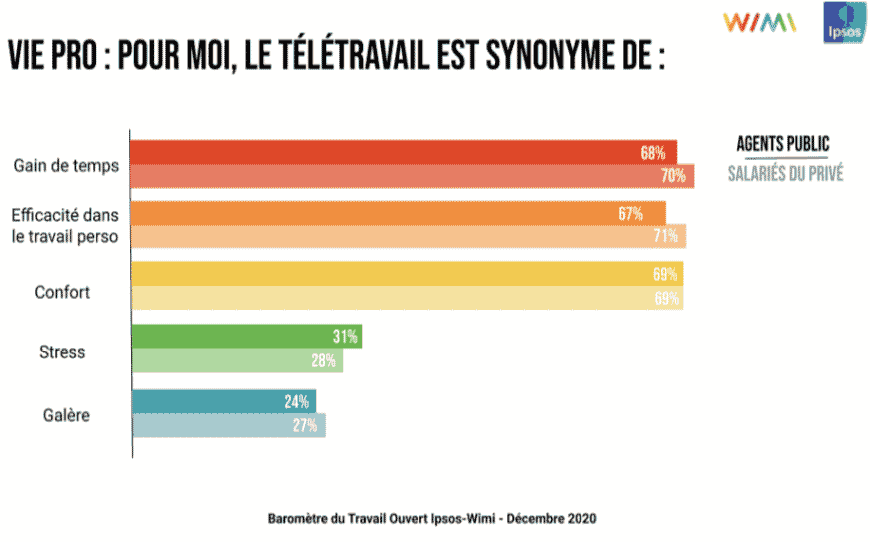
- 2020 has triggered a revolution in the organization of work in the public service. Agents draw a very positive assessment of teleworking: two thirds of them (67%) experienced the second lockdown well from a professional point of view. Teleworking is synonymous with saving time (68%) and efficiency in personal work (67%).
- And tomorrow? Very marginal before the health crisis, teleworking is expected to become widespread: three quarters of agents (75%) now want to work remotely on a regular basis.
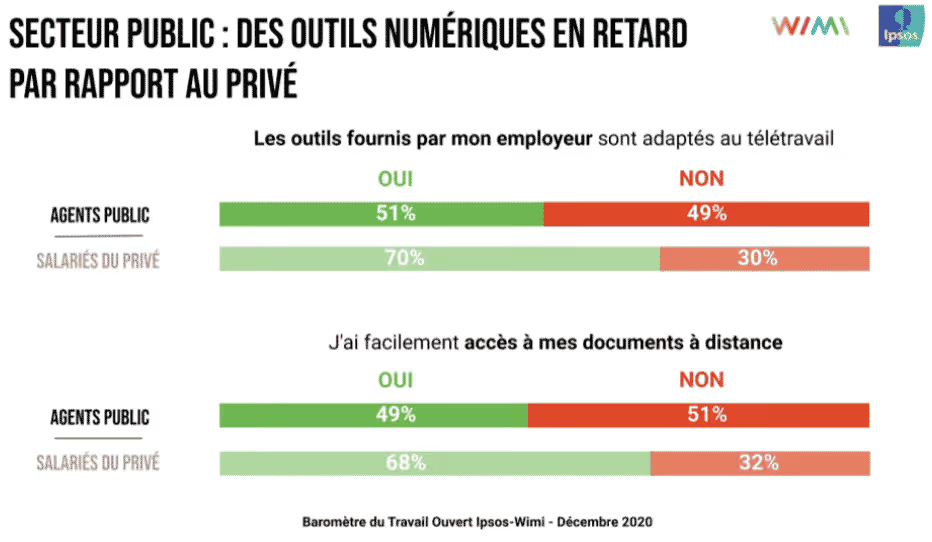
- The lack of appropriate tools (software in particular) is the first obstacle in the deployment of teleworking in the public service. One agent out of two (51%) cannot access their documents remotely.
- The deployment of teleworking is facing a cultural barrier, Presenteeism: two-thirds of agents (65%) believe that in their organization, “people stay in the office to show that they are working”.
- 92% of agents think that the State should devote at least half of its digital purchases to French software. However, used every day, American software arouse distrust: half of agents do not trust US software when it comes to protecting professional data (51%). French and European software is popular.
1. The agents were not prepared for the shock of 2020... but draw a largely positive balance from their experience of teleworking.
- The vast majority of agents (73%) think that their organization was not ready to face the first lockdown (vs. 52% in the private sector)... and they were still a majority to think that it was still not so for the second lockdown this fall (51% against 40% in the private sector).
- However, the agents draw a largely positive balance from this experience: two thirds (67%) experienced the second lockdown well from a professional point of view. Teleworking is synonymous with saving time for 68% of them, efficiency in personal work (67%) and even comfort (69%), figures comparable to those of private employees. Only a minority of agents consider that teleworking has been synonymous with “hassle” (31%) and “stress” for them.).
- With lockdown, however, many agents have also discovered the intrusion of work into their private sphere. 58% consider that teleworking rhymes with “extended hours” and only 56% think that teleworking is synonymous with better work/life balance.
- Agents now want to “transform the test”: 75% want to work from home regularly and 58% at least one day a week. However, a large majority of agents want the office to remain the main workplace: 81% want to work there most of their time.
- So will 2020 be the year of the big change in remote work? This is what a majority of public officials believe — 59% predict that “tomorrow there will be more remote work” in their organization and that “the organization of work will be permanently impacted by the crisis.”
2. Two obstacles, cultural and technical, still need to be removed in the public sector
- The culture of presenteeism is still (too) strong: 65% of agents believe that, in their organization, “people stay in the office to show that they are working”. 53% even believe that people who work remotely “are considered to be hiding places” (7 points more than in the private sector).
- The inadequacy of tools is an obstacle: for agents, equipment problems are the first factor that “makes it difficult to develop teleworking” in their organization while this explanation only comes in 3rd place in the private sector.
49% of agents believe that the tools provided are not suitable for teleworking and less than one in two agents say that they have easy access to their documents remotely.
And yet, the need for collaborative work tools is obvious: 93% of public officials think that for each project carried out as a team, the people who collaborate on the project should have online access to all the documents.
3. Lockdown acted as a “super-teller” of work culture.
The agents who coped best with the lockdown were those who were already working in a team that cultivated open work:
- Transparency : in organizations where “the exchange of information between departments is encouraged”, 71% of agents “experienced this period of confinement well from a professional point of view”: this is 10 points more than organizations where the exchange of information is not encouraged.
- Team spirit : in organizations where teamwork is encouraged, 71% of agents think that teleworking is synonymous with saving time: this is 12 points more than organizations where teamwork is not encouraged.
- Trust: in organizations where the hierarchy trusts employees, 70% of agents “experienced this period of confinement well from a professional point of view”: this is 8 points more than organizations where the hierarchy does not trust employees.
It is also an opportunity to refute certain stereotypes concerning the public service: globally, officials judge, at levels comparable to and sometimes higher than those in the private sector, that their organization promotes teamwork (74% vs. 75% in the private sector), trust (78% of public service employees), trust (78% of state public service employees believe that trust reigns between colleagues vs. 77% in the private sector), trust (78% of state public service employees).) and to a lesser extent, transparency (68% vs. 75% in the private sector).
4. Data protection: digital patriotism is fuelled by distrust of American tools.
Lockdown and widespread remote work have led workers (agents and employees) to host documents on the cloud and exchange more by videoconference, chat, messaging, etc. Therefore, the question of digital trust arises, a particularly sensitive subject when it comes to public data manipulated by agents.
- In terms of the protection of professional data, the surveyed assets place greater trust in French and European software than in American software, that barely reach the average. Chinese tools, for their part, suffer from a strong distrust. There is as much trust gap between Chinese and American software (1.5 points) as between American and French software.
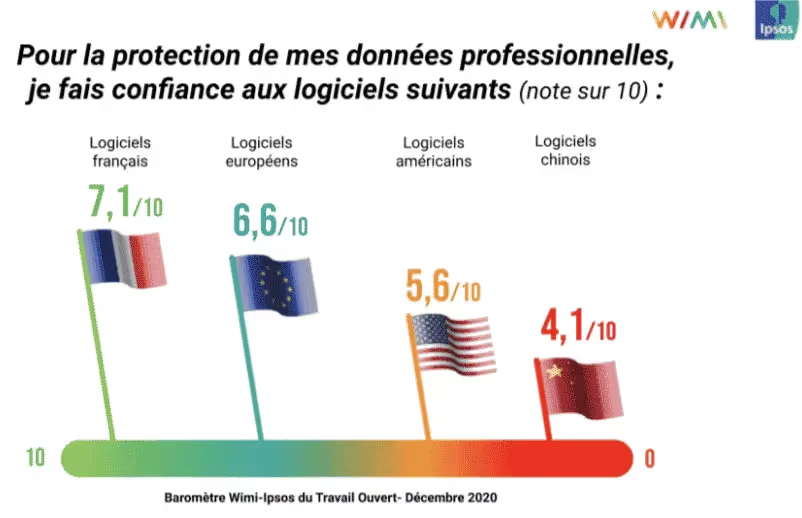
- When it comes to the protection of professional data, three quarters (73%) of respondents do not trust Chinese software; half of the people surveyed (49%) do not trust US software. A distrust two and a half times greater than that shown for French software (21% only).
The State should buy more French and European software:
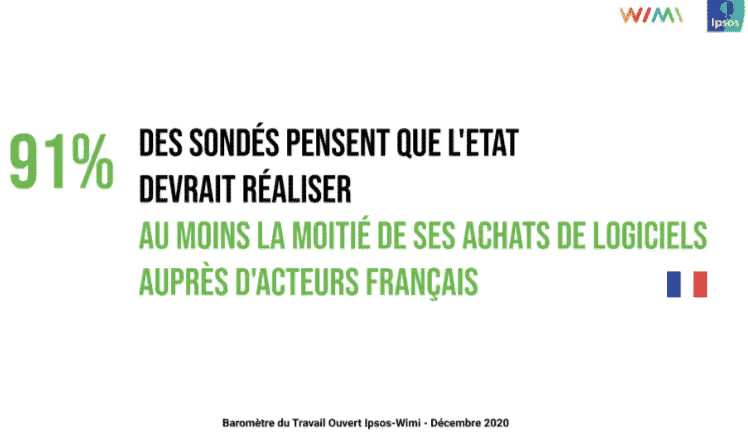
- 91% of respondents think that the State and the public sector should make at least half of their software purchases from French actors (including 41% of “strongly agree”);
- 88% think that the undertakings should make at least half of their purchase from French players.
- An almost as large proportion considers that the State (85%) or businesses (84%) should buy from European companies.
The testimony of Antoine Duboscq, President of Wimi
” This revolution in teleworking in administrations goes hand in hand with the great movement of data migration to the Cloud. The crucial question of the protection of this professional data therefore arises, especially with the highly sensitive data of administrations. As the President of the Republic recalled in September 2020, “we must reopen the battle of the Cloud” in the face of American and Asian giants.
This survey is hopeful because it shows the plebiscite of public officials and employees alike for a form of digital, French and European patriotism. In a social and political context marked by divisions, tech made in France is a unifying social subject, a shared cause.
I also retain from this first Barometer a very clear correlation between the effectiveness of remote work and criteria related to the transparency of information, team spirit, accountability in project mode, what I call “open work”. At Wimi, through our software, we aim to stimulate this open work, which is more fulfilling for employees and more agile for organizations.”
About Wimi
Wimi, French software publisher and leader in professional collaborative tools, is a player committed to digital sovereignty and shared digital transformation.
Wimi equips the National Assembly, the Senate, several ministries and public services as well as the Government Information Service (SIG). Its integrated platform offers a complete set of functionalities to collaborate in an agile way in project mode. : chat, video, sharing documents, drive, tasks, diaries.
Since 2010, the company has developed solutions exclusively developed, operated and hosted in France, in strict compliance with the General Data Protection Regulation (GDPR) and operating outside extraterritorial regulations (e.g. Cloud Act US).
In 2020, WIMI was one of the founding companies of the Play France collective.
Methodology
The survey was conducted by a self-administered online questionnaire from 10 to 20 November 2020, at the heart of the second lockdown, with a sample of 500 public sector employees and 500 private sector employees who work every day or several days a week in an office. Representation was ensured by the quota method after stratification by region.