How do you create a collaborative space?
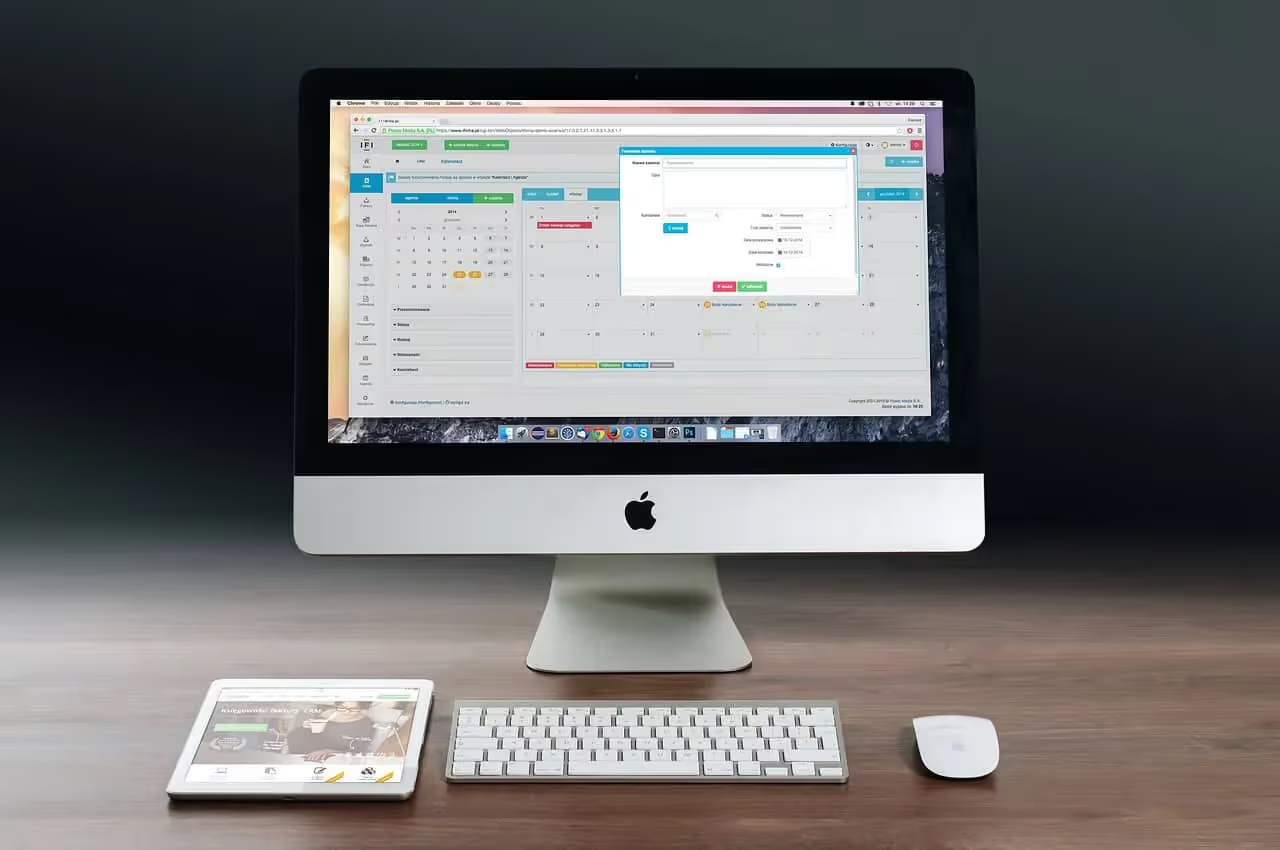
A collaborative space is a place where team members work together on projects, share information effectively, and communicate fluidly. This space offers you the opportunity to centralize data in one place to improve the performance of all your actions. Let's see how to create a collaborative space to exploit its full potential.
What is the point of a collaborative space?
A collaborative space is designed to facilitate teamwork and boost productivity. It provides an environment where individuals can interact, share ideas, and achieve common goals more effectively. By deploying such a space, you will be able to streamline communication with instant messaging tools, promote creativity and innovation through online brainstorming sessions, but also increase productivity by tracking tasks in an easy way.
An essential advantage of the collaborative space is that it is accessible anytime and anywhere via a simple internet connection. Therefore, it promotes interactions, reinforces the sense of belonging and greatly improves the flexibility of the company by making it possible to adapt to different working methods (face-to-face, hybrid and remote).
Create a collaborative space in 7 steps
In seven simple steps, you can create a collaborative space to strengthen your team's performance.
1. Define your goals
The first step is to accurately identify the reasons why you want to create a collaborative space. Is it to strengthen communication? To share resources? To manage projects?
During this preparatory phase, you should also ask yourself what results you expect from the deployment of the online space. By taking the time to ask yourself the right questions, it is possible to more clearly guide the layout of your space and the choice of collaborative tools.
2. Involving users
The space you are going to set up must above all meet the needs of its future users. For this reason, we recommend that you consult them in order to fully understand their needs and expectations.
You can use a variety of approaches such as organizing workshops or creating surveys. The important thing here is to gather ideas to identify the essential functionalities and the most suitable collaborative tools.
Note that by involving users from the start, you promote their adherence to the project and significantly increase the chances of success of your collaborative space.
3. Choosing your collaborative tool
In order to be used by your team, the collaborative tool must necessarily be intuitive and easy to use. Choose a tool that is available on different devices (computers, tablets and smartphones) to allow each user to work effectively, regardless of their geographical location.
Many efficient solutions exist on the market to support your projects. These include Trello, which is renowned for its project management and task tracking functionalities, or Notion, which is a versatile platform focused on taking notes, managing databases and creating wikis.
You can also opt for Slack or Google Workspace depending on your needs. The important thing is to take the time to test different tools in order to determine which one best fits your needs and your budget.
4. Integrate the right technologies
If you want to take full advantage of your collaborative space, it is necessary to prepare a suitable environment. Your solid technological infrastructure will rely in particular on a reliable high-speed internet connection and accessories dedicated to videoconferencing (cameras, microphones, screens)
To preserve your corporate data, also provide a secure system dedicated to backing up and storing files.
5. Train users
Once the foundations of your collaborative space are in place, take the time to train users. Organize training sessions open to everyone to explain how to effectively use space and associated tools.
This type of initiative is also an opportunity to share best practices related to cybersecurity with your employees in order to avoid data loss and fight against possible phishing attempts.
Provide your contacts with comprehensive guides or tutorials to enable them to solve the most common problems independently.
6. Create usage rules
In order to ensure the smooth functioning of the collaborative space, it is crucial to define clear rules that are shared by everyone beforehand.
If it is a physical collaborative space, establish rules of courtesy to promote respectful and fluid exchanges. Define rules for using equipment and encourage everyone to keep the space clean and tidy.
For a digital space, the most important thing is to clarify roles and responsibilities in order to preserve business data. Set up a process for validating and monitoring tasks in order to maintain team performance at all times. Finally, deploy computer security policies to protect your sensitive data.
7. Evaluate and improve
Creating a collaborative space is an iterative process, so it is essential to evaluate it regularly and to improve it continuously.
Gather user feedback through satisfaction surveys, discussion groups, or an idea box to identify all areas for improvement.
Follow certain key performance indicators such as the number of connections, the rate of use of tools or the number of collaborative projects in order to identify areas for optimization. Then make the collaborative space evolve according to the evolution of needs and the evolution of available technologies.
What is the best tool for creating a collaborative online space?
A tool for creating a collaborative space must include certain essential elements. Thus, it should ideally integrate instant messaging and a videoconferencing application to facilitate exchanges between group members. Shared dashboards, task lists, and calendars are important for tracking the progress of projects. Options of file sharing for businesses, version management, great ease of use and data security complete a quality tool.
Wimi is the ideal collaborative space because it integrates all the elements mentioned above and more! Indeed, Wimi is an all-in-one platform that brings together all the tools necessary for collaboration in one place. From real-time collaboration to advanced project management, you can fully exploit the potential of digital technology.
Wimi also takes care of your business data by integrating robust encryption, a multi-factor authentication system and access rights management. In addition, Wimi hosts your information in data centers located in France to maximize security and guarantee digital sovereignty.