Can secure video conferencing replace meetings?
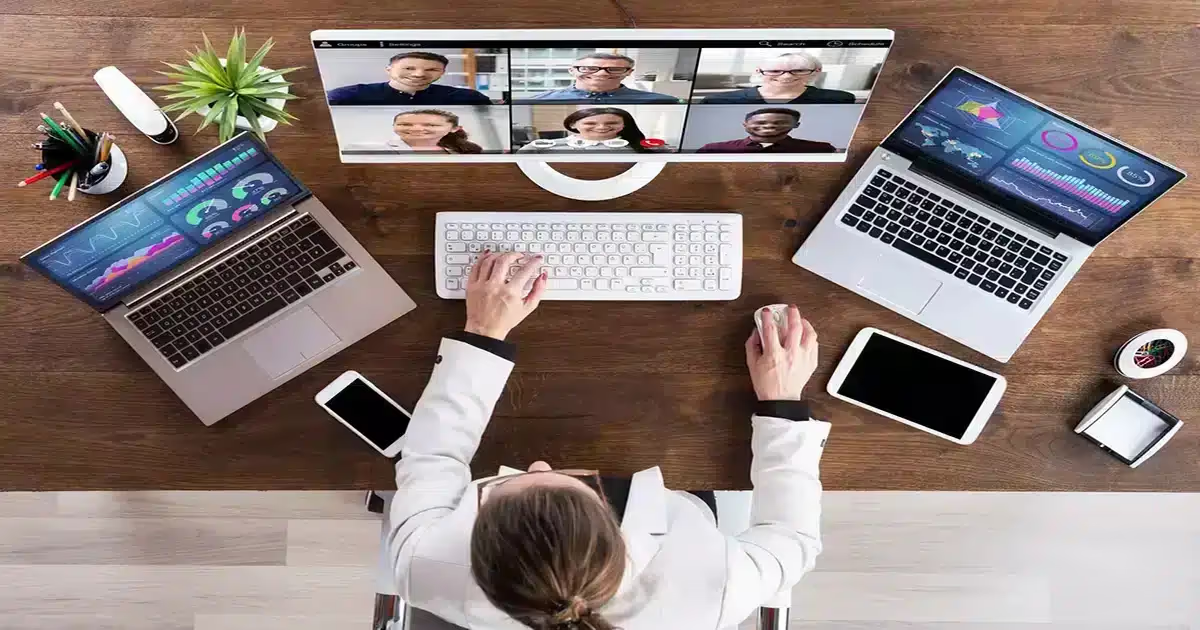
Since the pandemic, videoconferences have taken hold in our private lives, allowing us to continue to have an aperitif with our family and friends despite confinement or distance, or to follow our yoga class without leaving home. In business, with the generalization of teleworking, videoconferences have almost entirely replaced physical meetings. Today, Zoom, Skype, and Google Meet are among the most used tools for making video calls with colleagues who work remotely.
However, despite an increase in the number of video conferences, it is questionable whether virtual meetings in business will completely replace physical meetings. For that, let's compare the pros and cons of these two ways of getting together.
Video conferencing vs physical meetings: the pros and cons
Learn the pros and cons of secure virtual meetings and in-person meetings.
Video conferencing benefits
- Video conferences are an effective communication and collaboration tool for easily bringing dispersed teams together. You can thus organize meetings with your employees who are teleworking or who work in offices located abroad or elsewhere in France.
- You save on travel and possibly accommodation costs because your employees are no longer required to travel to attend a meeting.
- According to a study by Beekast and OpinionWay, 70% of managers find remote meetings more effective and faster than face-to-face.
- According to the same study, 68% of managers surveyed find that remote meetings promote speaking because shy employees speak more easily behind their screen than in a meeting room.
- Technology is making virtual meetings better. For example, participants can exchange messages and documents during the meeting via instant messaging. During meetings with participants speaking different languages, speech recognition makes it possible to generate live subtitles. Finally, some software allows you to automatically record and transcribe the meeting to keep a written record.
Benefits of physical meeting
- Human contact is the main benefit of physical meetings. You meet with your colleagues around a table to discuss, discuss and/or solve a problem. Personal relationships between employees develop more easily and trust and camaraderie are established.
- In person, you can know what your employees really think by directly seeing their reaction and by analyzing their non-verbal language such as body language when faced with a new project or a delicate situation.
- A well-prepared and well-animated physical meeting can be very productive. Management, motivation and the valorization of team work often have more impact face-to-face than at a distance.
- In a physical meeting, participants are more involved. They can hardly divert their attention or do anything else, especially if the meeting is dynamic and participatory.
- Finally, physical meetings are essential to establish a solid relationship with a customer, for example, or to deal with an important subject (negotiating a contract, celebrating an important event, etc.).
Video conferencing disadvantages
- Network problems, poor Internet connection, pixelated image or inaudible sound, the use of digital tools often involves technical problems, connection problems and failures that hinder meeting productivity.
- The security and confidentiality of exchanges can be a problem depending on the type of software you use.
- The lack of human contact is a major disadvantage of video conferences. Remote work and the abuse of virtual meetings can hinder the development of personal relationships between team members. Alone in front of your screen, it is difficult to exchange complicit glances or smiles with your collaborators and body language, essential to know what the participants really think, is indecipherable through a screen.
- Beware of zoom fatigue, a real phenomenon caused by the abusive use of videoconferences.
- It's easier to take your attention away from a video conference. Also according to the study by Beekast and OpinionWay, 68% of managers say that they sometimes divert their attention from time to time and 50% say that they regularly have difficulty following a remote meeting until the end.
Disadvantages of physical meeting
- In face-to-face meetings, timid employees do not necessarily dare to speak up and/or will not dare to say what they think or give their true opinion for fear of being judged. They will talk more easily by videoconference, hidden behind their screen.
- For geographically dispersed teams, physical meetings can be a significant cost to the business if all participants have to travel to the meeting location.
- If poorly organized and conducted, face-to-face meetings can be time-consuming, boring, and lead to no concrete results. Follow these tips to facilitate a team meeting.
Video conferencing and physical meetings: two essential tools
These two types of meetings each have their advantages and disadvantages. While video conferencing is very practical when part of your team is working remotely, physical meetings are still important for strengthening team cohesion and relationships between employees. Choosing one type of meeting over another will therefore depend on several factors such as the objective of the meeting, the number of participants, the culture of your company, etc.
The ideal is therefore to combine these two modes of operation as much as possible. For example, if you can, try to bring your employees together physically several times a year to develop a sense of belonging to the company and to the team, and to promote relationships between members of your team.
Finally, follow these tips for organize a virtual meeting in good conditions, and discover the 10 best video conferencing tools to equip you properly.