OKR method: Definitions and advantages of the method
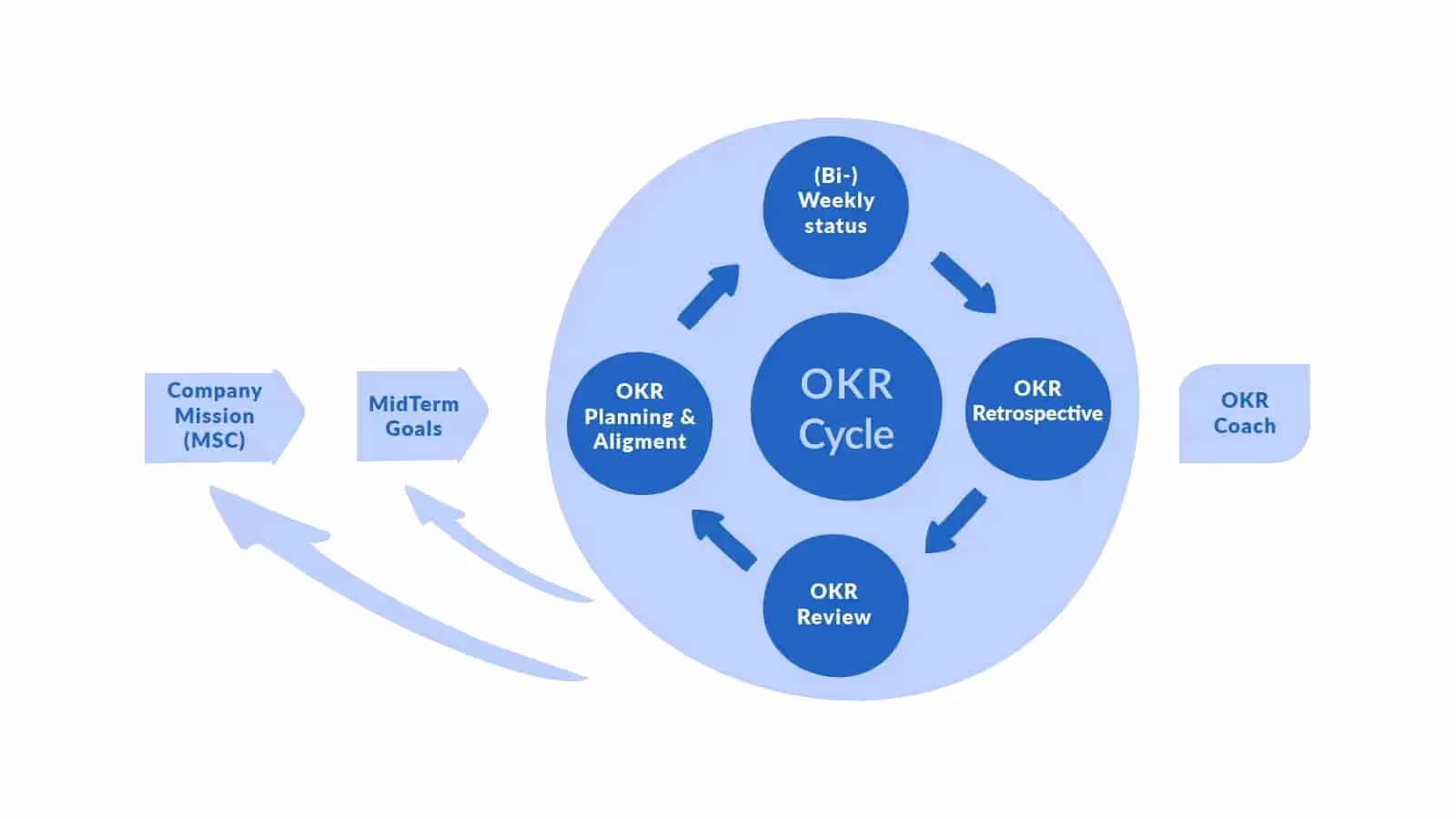
If your business has ambitious goals, it's in your best interest to discover the OKR method. This approach offers a direct and quantifiable approach. With it, you can plan goals, align individual efforts with business goals while maintaining agility. To help you explore this method, we present its history, but also how it works and its advantages.
What is the OKR method?
The OKR method (Objectives and Key Results) or “Objectives and Key Results” refers to a planning method. Andy Grove developed this method at Intel in the 1970s. His objective was then to align the company's resources towards a common goal.
However, it was at Google that she became famous under the impetus of John Doerr, who had previously worked with Andy Grove. The performance of this method has led it to leave the walls of Intel and Google and become an approach very popular with technology companies in the United States.
Which companies have deployed the OKR method?
Three major companies use the OKR approach:
- Google: The American company has made the OKR method a central part of its corporate culture. Google managers used this method in 2008 especially when they wanted to increase YouTube's revenue.
- Twitter: The OKR method was deployed in order to combat abuse on the social media platform. It was used to measure the company's progress by taking into account the percentage of abusive tweets and the response time of agents.
- LinkedIn: To increase user engagement, LinkedIn took advantage of the OKR method by tracking the number of articles published and the increase in time spent on the social network.
How does this method work?
In order to fully understand how the method works, it is necessary to study the two elements that make it up:
- O is for Objective;
- KR for Key Results.
The objective
To begin with, it is necessary to precisely define the purpose of the business. Of course, the goal should be ambitious, as it is used to increase team engagement. All employees should feel inspired by the purpose of OKR.
The objective must be significant enough to give a clear direction while being achievable in a concrete way.
The key results
So that the goal does not remain a distant and unachievable goal, the second part of the OKR method aims to streamline actions in order to achieve the goals set. Key results are thus formed by key performance indicators that are measurable.
Key results can for example take the form of a 20% increase in sales or the acquisition of 50 new customers every month.
Setting up OKRs
Once OKRs have been clearly defined, they can be shared with the team of collaborators. They are then motivated by the establishment of ambitious, achievable and measurable goals.
Note that it is necessary to measure performance over time to ensure that objectives are successfully achieved. It's up to you to select the most relevant period based on your business processes. In most cases, OKRs are set on a quarterly basis. At the end of the period, the OKRs are evaluated and new OKRs are defined for the following period.
This approach is ideal for creating a culture of performance, agility and continuous improvement. At each cycle, it is possible to measure and adjust performance.
What are the advantages of the OKR method?
The OKR method has been adopted by many companies because it has demonstrated its relevance. Indeed, it offers numerous advantages to the organizations that implement it.
Increase in alignment
First and foremost, the OKR method is perfect for aligning efforts and teams toward a common goal. The overall efficiency of the company is increased, as energies are not dissipated in tasks with low added value. On the contrary, everyone acts in common to achieve the goals set.
Creating a culture of responsibility
Then, OKRs make it possible to design a framework for measuring performance. If the OKR approach promotes the achievement of objectives, it is because it makes it possible to monitor progress and adopt a rational approach.
In addition, the commitment of each employee is maximized, as everyone strives to participate in the common effort. In particular, KPIs offer the opportunity for all employees to observe how personal efforts impact global goals. This virtuous circle then creates a culture of responsibility.
Increased flexibility
The OKR method improves business agility because OKRs are set on a regular basis, evaluated, and adjusted. This approach is ideal for being able to adapt quickly and maintain a high level of flexibility.
Depending on market developments and circumstances, the company can thus realign or readjust its efforts to optimize its performance and strategy at any time.
Establishing a culture of transparency
With the OKR method, each employee can take ownership of the company's joint efforts. By sharing the various OKRs with all stakeholders, you promote transparency and the involvement of everyone.
Indeed, employees are all the more motivated when they understand the objectives and perceive the impact of their work on them. In addition, communication becomes more fluid and employees can be retained in the long term.
A relevant method to increase performance
If the OKR method is relevant, it's because it allows you to improve performance while being very flexible. Concrete, it allows you to infuse a culture of responsibility within the company, develop a road map and achieve your goals.
Of course, for you to take full advantage of the OKR method, it is essential to follow a suitable method in order to deploy it effectively. This is what we will see in a future article. We will give you all the information you need to effectively implement the OKR method in your organization or company.