Lean management: An efficient agile method
Do you want to optimize your processes and put an end to waste? Consider adopting lean management. Coming from Japan, this efficient management method allows you to maximize value and implement a continuous improvement approach. Ideal for increasing customer satisfaction, reducing costs while accelerating production, the Lean approach is based on certain essential principles that we present to you in this dedicated article.
What is lean management?
Lean management is a management method aimed primarily at reducing waste. The objectives of the approach are to improve processes, increase the speed of production and increase product quality.
The Lean approach has its origins in Toyota's production system (TPS or Toyota System Production). TPS was invented by Japanese engineer Taiichi Ohno which was inspired by Fordism and Just-in-Time. His method aimed to reduce waste, increase customer satisfaction while facilitating production in the automotive industry.
It was not until 1988 that the Lean method was born. in an article entitled Triumph of the Lean Production System written by John Krafcik.
The basic concepts
To implement management methods such as the Lean method, it is necessary to fully understand the fundamentals. The Lean approach that strives for operational excellence is based on 5 fundamental principles.
1. Identify value
If you want your customer to buy your product or service, it is essential to identify its value. It's your way of solving a customer problem. Thus, if a process is not aimed at supporting the customer in their search for a solution, it is a waste of time and resources.
So start by identifying the value of the product in order to Maximize it and eliminate all the elements that could reduce it or hinder processes.
2. Mapping the value chain
Since it is necessary to eliminate elements that do not add value, it is necessary to set up a flow map. Once you have fully identified the actors, tasks and actions, you need to analyze your feeds to determine what items can be removed.
According to Taiichi Ohno, there is Seven types of waste (also called muda): overproduction, waiting, waiting, transport, overstocking, unnecessary movements, unnecessary processes and the production of defective parts.
3. Create a process
You've identified opportunities for improvement, so it's time to deploying a new organization of work. Designing a new workflow for your production process will increase efficiency.
The ideal is to have employees and teams work together to create these new processes. Actions and tasks should be divided into sub-tasks and it is recommended toeliminate anything that could create bottlenecks.
4. Designing a pull system
The Japanese system is based on a “just-in-time” production concept. In other words, A process only starts once the previous one has been completed. To apply this approach, it is essential to be very rigorous.
Unlike the “Push” approach, which works on production forecasts, the “Pull” or pull-down approach is triggered by customer demand. That is the reason why the working environment and methods must be perfectly optimized to meet customer expectations in a timely manner.
5. Refine your process
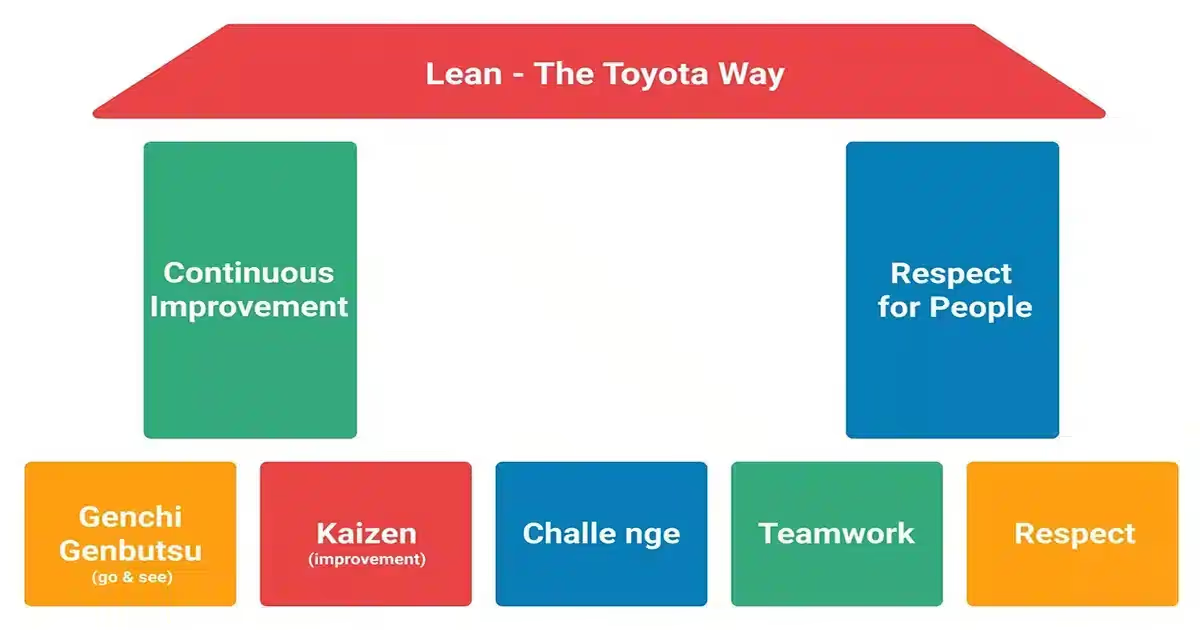
Lean management must be part of a culture of continuous improvement. Regular meetings, effective teamwork and performance monitoring make it possible to implement productivity improvement practices.
The advantages of the Lean method
The regular improvements made possible by the Lean method are ideal for accessing numerous benefits for your business:
- Process improvement: Process mapping, optimizing them and eliminating waste allow streamlining actions and improving processes and team productivity.
- Increase in quality: With its iterative approach, the Lean method is perfect for identifying potential improvements. Small steps by small steps, problems are solved and the product is refined, improving quality.
- Reductions in deadlines: With more efficient processes, the elimination of waste and bottlenecks, this management method contributes to an improvement in delivery times as well as to a reduction in production costs.
- Increased satisfaction: The Lean method is focused on added value. Continuous improvement combined with an understanding of customer needs significantly increases their satisfaction.
What are the tools of lean management?
To successfully deploy the Lean approach, it is appropriate to use certain specific tools. Indeed, the identification of waste, the optimization of processes and the efforts to measure improvements require using the right tools.
The tools can be classified into two categories: software techniques and tools.
Some of the techniques used in the Lean method include:
- Value chain mapping: Also called Value Stream Mapping, it consists, as we have seen, in representing processes to identify waste, but also possible opportunities for improvement.
- The 5S: Used to optimize the workspace in Japanese companies, the 5S technique is based on 5 principles which are sorting, storage, cleaning, standardization and maintenance.
- Kaizen: A pillar of continuous improvement, this method requires all employees to get involved to identify the problems to be solved, and then solve them collectively and gradually.
- Kanban: Designed to visualize and manage workflows, the Kanban method uses cards representing tasks to be completed, in progress, or completed.
In addition to these practical tools or methods, we recommend that you:to also use software tools. For example, these can take the form of a collaborative work suite. You will thus be able to centralize documents and exchanges in order to mobilize teams around a common objective and effectively deploy the Lean method. Such tools also integrate the Kanban method as well as functionalities to create value chain maps.
John Krafcik, Triumph of the Lean Production System, 1988