How do you create your sales pipeline?

Tired of seeing potential customers get away from you? Do you lack efficiency in sales management? To be successful, you must be organized and rely on a reliable structure that allows you to identify your customers' journey, analyze and monitor your entire sales process, and thus identify profitable business activities and those that can be improved.
There is an indispensable tool to effectively manage your sales: the sales pipeline. Thanks to it, sales team members can monitor the progress of their prospects and implement the necessary actions.
Each company has one or more pipelines (depending on the products and services sold) that are unique to them and that describe the traditional buying journey.
Learn what a sales pipeline is and how to build your own.
What is a sales pipeline?
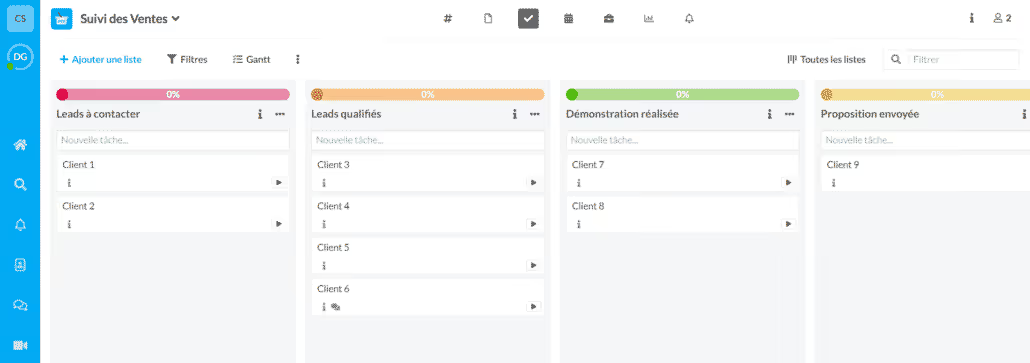
A sales pipeline helps you visualize your sales process, i.e. the various processing steps (from making contact to closing the sale) that make it possible to turn a lead into a customer.
It is an indispensable tool for sales teams who must constantly juggle several prospects and who must not lose sight of any transaction.
The sales pipeline makes it easy to reach your goals by dividing the sales process into several small tasks that are easy to follow. This makes it easier for you to know what stage your prospects are at and when your conversions are failing.
It is also an important tool for the sales manager who wants to know if their sales process is working well because it helps to identify the most profitable business activities for your business. Without a sales pipeline, it can be difficult to know how effective your sales process is and where you can improve to make it more efficient.
How to build your sales pipeline
Follow these 5 steps to build an effective sales pipeline.
1. Know your product, your customers and your arguments well
There are basic rules for selling your products or services well. In particular, you must master these fundamentals:
- your product : knowing your product well allows you to present it favorably to your potential customers and to answer all their questions with confidence;
- the profile of your customer : because you know perfectly the profile of your prospects and their problems, you know what lever to act on to trigger a sale;
- your sales pitch : prepare an irresistible commercial speech that will prove that your product is THE solution to solve the problem of your potential customer.
2. Define the stages of your pipeline
A business relationship works like a romantic relationship: you don't ask the person to marry you or move in with you on the first date. You have to go through several steps, getting to know each other until the final decision (here the purchase of your product). These steps are different for every business. Note that the more complex the product, the longer the sales process and the more steps the pipeline will have.
To define your own steps, think about the buying journey that a prospect must follow to become one of your customers.
Here are the three stages that every lead goes through:
- Awareness the opportunity or the problem encountered;
- Consideration: the buyer has identified his problem or opportunity, he has determined his needs and his evaluation criteria, and he is learning about existing solutions;
- The ruling : the prospect is ready to take action and compare sellers and offers.
Following this path, the phases of a pipeline are:
- Making contact : the prospect comes into contact with your company.
- Making an appointment : he agrees to meet with you to find out how you can help him.
- Encounter over: the prospect came to the appointment and you explain the next steps to him.
- Proposed solution : he is interested in your product.
- Sending an offer : the prospect studies your offer.
- Case signed
- Lost business
3. Track the behavior of your prospects
By analyzing the average time that each lead spends at each stage of the sales pipeline, you can conclude that those who spend more time are the ones who convert into customers. Your sales team will then be able to determine:
- who are the prospects most likely to convert,
- the percentage of prospects who move on to the next stage, i.e. the conversion rate for each stage,
- monthly and/or quarterly revenue forecasts.
Also, analyze what is the trigger that encourages your prospects to take the next step, and pushes them to buy your product. For example, is it watching a video, requesting a demo, or trying the product for free?
4. Turning these observations into numbers
How many leads do you need at each phase of your pipeline to reach your goals? To do this calculation, divide your monthly revenue goals by the average transaction amount. This will give you the number of transactions you need to reach your goals. Then, divide that number by the conversion rate for each stage.
For example, your monthly goal is €100,000, the average transaction amount is €2,000, and the conversion rate during the trial phase is 80%. To reach your monthly goal, you need to make 50 deals per month (100,000/2000=50), and your sales team needs to have at least 63 leads to reach that goal (80% of 63 equals 50).
Use this data to define the actions to be implemented by your sales and marketing teams to reach the desired number of prospects and encourage your prospects to move from one stage of your sales pipeline to another (sending a follow-up email or a newsletter, calling, etc.).
5. Create or adapt your sales process
Now, use this data to create your sales process by following these steps:
- assess your current sales process (if you have one)
- Analyze all the sales you've successfully completed to understand what worked well
- improve your strategy by drawing on data from your sales pipeline.
Creating your sales pipeline is not easy, but thanks to this tool, you will improve your results and succeed in developing trusting relationships with your customers. To help you, you can use the following model: