5 steps to effective project management

Launch a new product, build a new building, implement a new software, recruit a new employee... Every day, businesses have to manage a multitude of different projects. In order to be efficient and profitable, they must ensure that project management, regardless of their size, is masterfully managed by their teams.
The success of a project cannot be improvised. According to the PMI Pulse of the Profession 2021 report, 12% of projects were considered failures in 2021, 34% suffered from goal-drifting, and 35% failed due to a poor budget. Successful projects therefore require preparation, organization and planning.
Thus, to effectively manage your projects and achieve your goals within the set deadlines, you must follow the key steps of the project management.
Reminder: what is project management?
Also called project management, project management consists of organize the progress of a project from A to Z, i.e. from its conception to its delivery. To do this, the project manager and his team must define the objectives, determine the human and material resources required, the budget and the deadlines, and identify the constraints and possible risks. To coordinate and carry out the required tasks, they can rely on a set of adapted techniques, methods and tools.
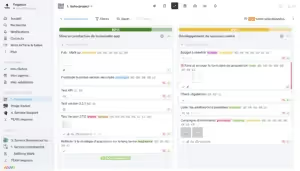
The 5 key steps for effective project management
Each project is different and you will not manage two projects in the same way. However, it is necessary to follow steps that are essential to the management of all your projects in order to ensure their success.
1. The design
This is the initial phase of any project. This step is crucial because it consists in establishing the main lines of the project. That's when you define The objectives of the project (in particular thanks to the SMART method) and what is expected of you, in other words what are The deliverables. You should also determine:
- What are The deadlines that you have;
- What is The budget necessary for the implementation of the project;
- What are human and material resources that you will need.
Finally, it is also important to identify The constraints that could interfere with the smooth running of the project (cost, scope, time, quality constraints, etc.).
It is also during this stage that you set up your project team, that you organize a kickoff meeting and you start producing the project documentation such as the project charter and the project plan.
2. Scheduling
Once the outlines of the project are clearly defined, it is time to move on to planning. This is an essential step in project management. To succeed in your project, you must break down into several steps and milestones.
So, for each deliverable, you must identify all tasks necessary for its realization. Then, these tasks should be prioritized and their dependence on each other determined. For example, before building the roof of a house, all four walls must first be erected.
Once you have listed all the tasks to be completed, you need to Establishing the schedule. Keep room for maneuver by allowing 20 to 30% more time to avoid delays, and 10 to 20% more budget to deal with the unexpected while avoiding budget overruns.
Then you have to Determine who does what by assigning tasks to your team members based on their skills, knowledge, and experience. The question arises whether you have all the skills in-house or if you will have to use external skills (recruitment, service providers, freelancers, etc.).

3. The execution
We are now moving on to the concrete phase: the realization of the project. Now that everyone's roles have been defined, resources identified and deadlines set, it's time to follow the project action plan that you established in the previous step.
Produce the expected deliverables within the set deadlines. Organize project follow-up meetings with your collaborators to review the progress of the project on a weekly basis, address bottlenecks and find solutions.
4. The follow-up
In order to ensure the smooth running of your projects, you must imperatively set up key performance indicators or KPI (key performance indicators). Just like when you're driving your car to a specific destination, you need to know if you have enough gas to continue, how fast you're going, when to speed up, and so on.
So, the KPIs are essential to facilitate the management of your project. They give you a quick overview of the status of the project at any given moment. This accurate information allows you to assess the current situation and make an appropriate decision. The indicators also allow you to Compare the forecast and the real, and thus to better predict your next projects. There are indicators of cost, time, quality, and efficiency.
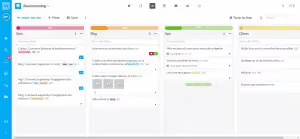
5. Closing and balance sheet
Once the project is complete, we move on to the closure of the project, an important step that should not be overlooked. This phase makes it possible to officially finish the project, to release the collaborators so that they can join other projects And of Take stock of the project.
We ensure that the project has been delivered to the customer and that the customer is satisfied. We check that all problems have been resolved and that all invoices have been paid. This is an opportunity to update and archive documentation that can be used as a basis for similar projects. Finally, we go back to the project to assess and understand what worked and what did not work, and identify lessons learned.
Finally, don't forget to thank your team for the work done and to celebrate the end of the project together.
To effectively manage your projects and promote collaboration within your teams, do not hesitate to use adapted tools such as project management software Wimi.