What is IaaS?
Cloud
5 min
Posted on
25/3/2026


There are various forms of cloud computing including IaaS, FaaS or SaaS. In this article, we help you better understand the specificities of IaaS in order to allow you to adopt the technological solution that best meets your business problems. We present you for this IaaS, How it works as well as Its use cases.
Let's start with a brief Definition of cloud or cloud computing. The latter refers to the use of networked computer servers accessible remotely via an Internet connection. This allows individuals or professionals to store and access data or to use electronic messaging or streaming applications.
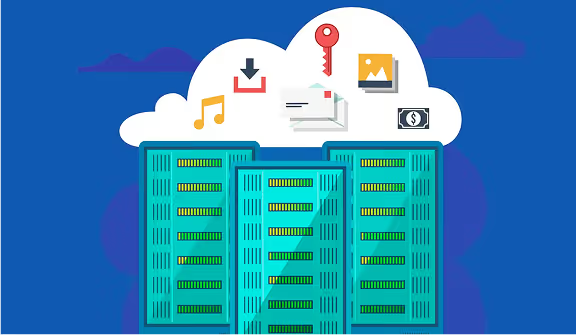
Among the various cloud offerings, there is what is calledIaaS or Infrastructure-as-a-Service. Through this cloud model, it is possible toaccess infrastructure resources on demand as needed. This includes access to servers, storage space, network, virtual machines, or computing capacity.
The advantage of this type of cloud environment is to benefit from solid IT resources without worrying about infrastructure development or data hosting. Your company can thus focus on its core business and outsource the technical part via a specialized supplier. The latter then takes care of all the necessary infrastructure by ensuring its maintenance and security.
Concretely, users access IaaS resources through a web portal or API. Depending on needs and workload, it is then possible to modulate these resources in order to optimize their use. All of this therefore represents a saving time and money very relevant and can promote the growth of the business that benefits from such services.
Cloud computing can be categorized into three main models. Each responds to very different use cases. You must therefore first select the type of cloud that meets your problems.
As we have seen, IaaS refers to provision of the basic elements of an information system such as servers or storage. The management of this physical infrastructure is the responsibility of the service provider, but you can act on the operating systems for example.
PaaS is mostly used in the software development sector. He provides access to an online platform for developing, deploying, and managing applications. Again, you don't have to worry about the underlying technical infrastructure.
Finally, SaaS provides the customer with software applications pre-installed and hosted on the cloud. Among these services, we can mention Netflix, Spotify or tools that allow the sharing corporate documents like Wimi.
Like any cloud approach, IaaS has both pros and cons. He is very It is important to know them in advance in order to successfully deploy your cloud solution.
Infrastructure-as-a-Service can be used in a variety of situations. Examples of use cases include, for example, thecomplex website hosting, therunning tests, the high performance computing Or the big data analytics.
Benefiting from an infrastructure in the cloud is also very interesting for improve disaster recovery. Indeed, the redundancy of information made possible by the use of servers scattered within the cloud assures you that in the event of a problem, your business will not face an interruption of services that could negatively impact your operations and your brand image.