Public, private or hybrid cloud: how to choose?
Cloud
5 min
Posted on
3/2/2026


In the digital age, the world is changing very quickly. The time when businesses stored their data on their computers or servers seems a long way away. Now, more and more companies are choosing the cloud to store their data (financial, personal or even strategic) as well as to access software, tools or resources. This is called cloud computing or cloud computing.
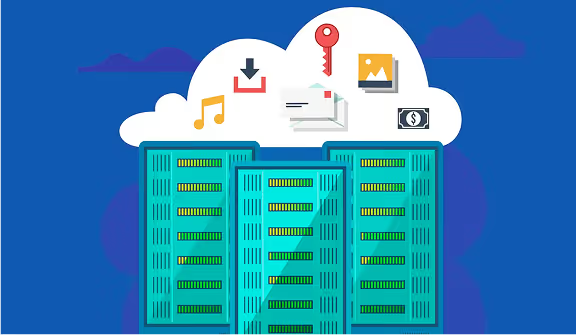
The cloud is a system that allows data to be stored as well as access to resources, data, and services on remote servers that are accessed via the Internet, rather than on a computer or external hard drive.
Individuals and professionals alike can store all types of digital documents (videos, photos, various documents, etc.) on the cloud and they can have access to a multitude of services: instant messaging (like Slack), project management software (such as Slack), project management software (such as Wimi), co-publishing tool (like Google Workspace), customer relationship management solution (such as Salesforce), document storage and sharing platform (like Dropbox), etc. These are what we call SaaS software for Software as a service, which are opposed to on-premise software.
The advantage is to be able to easily access the cloud from any device with an Internet connection (computer, smartphone, tablet), regardless of where you are. So it's a great system for hybrid or geographically dispersed teams.
The main advantage, It's because it's much easier to share your documents and data with colleagues, its customers or its suppliers rather than sending them by email. To do this, simply make your data accessible to the people you want and send them an access link.
Today, there are three types of clouds: public cloud, private cloud, and hybrid cloud. To help you choose the best solution for your needs, learn about the differences between each type of cloud and their respective benefits.
The public cloud is the core model of cloud computing and the one that is most commonly deployed. Contrary to what the name suggests, your data stored on a public cloud is not visible and accessible publicly. It is a set of servers, resources and services that you will share with a limited number of customers.
Here, the service provider takes care of the development, management, maintenance and updates of the cloud in order to ensure the use of a system that is always operational.
Among the advantages of this type of cloud, we note:
Generally, the public cloud is appreciated by start-ups and auto-entrepreneurs because it is an economical solution, quick to implement and scalable. However, it is not suitable for businesses that have high requirements, especially when it comes to security.
Unlike the public cloud, the private cloud is entirely dedicated to a single company, no sharing with another customer. This type of cloud is similar to a local infrastructure, meaning that the company has total control over all the resources (data, software and applications) that are stored on its own servers. These servers can be hosted on company premises and managed by internal teams, or they can be housed in datacenters and managed by an external provider.
The private cloud is customizable to meet the unique needs of each organization, especially when it comes to security. With the private cloud, the customer has direct access to a powerful and secure solution that they can fully control. On the other hand, setting it up represents a significant cost for the owner company, in addition to additional costs for deployment, configuration, management, and maintenance.
For the advantages of the private cloud, we can cite:
The private cloud is ideally suited for government agencies and highly regulated industries as well as for businesses dealing with sensitive data.
Bonus: find out How to manage your organization's sensitive data.
Some businesses with specific needs are looking for an intermediate solution. They can then opt for the hybrid cloud, an IT infrastructure that combines the characteristics of the public cloud and those of the private cloud.
The hybrid cloud is a mixed system that allows you to switch from one type of cloud to another, according to your needs. Software, applications, and data can be shared between public and private clouds based on various aspects such as security, performance, and cost.
For example, you can use the public cloud for your daily tasks as well as to store and archive certain non-sensitive files and emails, and then you can switch to the private cloud when dealing with sensitive information (financial, strategic data, etc.).
Here are the benefits of the hybrid cloud:
This hybrid solution is ideal for organizations working in multiple industries with different IT security, regulatory, and performance requirements as well as for businesses that are hesitant between public and private clouds.
Now you know the three types of clouds that exist. It's up to you to make your choice according to your needs.