What is collaborative editing and how do I use it?

When multiple people are working on different versions of the same document, difficulties can add up. The work is in fact heavily impacted by the frequent back and forth between contributors, the problem of managing the multitude of versions or the loss of information.
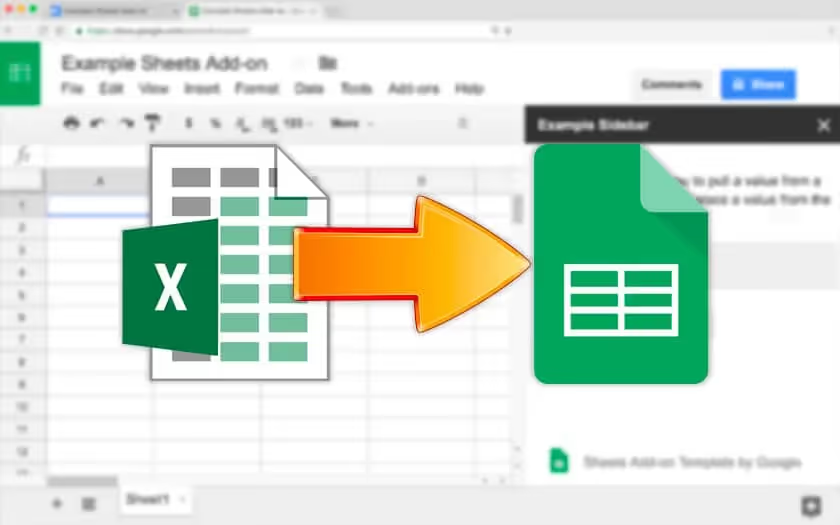
Fortunately, collaborative editing exists, which offers the opportunity for different members of a team to write on the same document and make changes to it in real time. To help you save time, streamline communication and boost creativity, in this article we explain how to exploit the full power of collaborative publishing.
How does collaborative editing work?
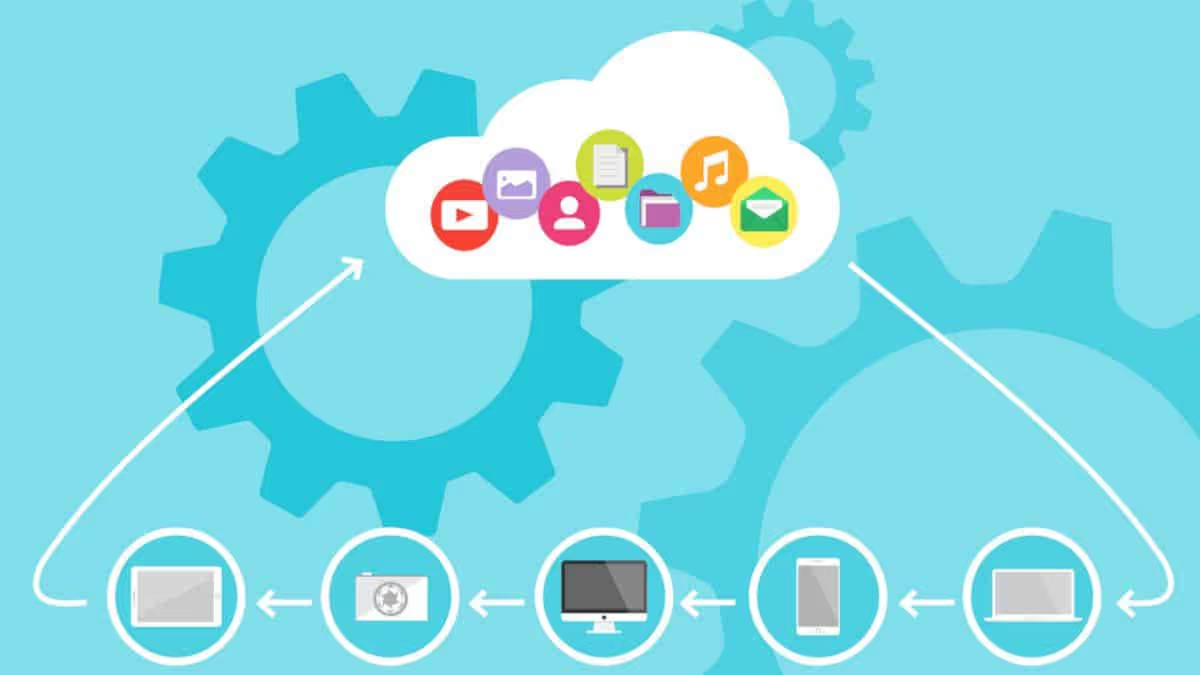
Collaborative editing allows different members of a team to work simultaneously on the same document, regardless of their geographic location. To do this, the document is stored in a shared space accessible to all collaborators. They can then make changes in real time, view version history, and communicate with other project participants.
Deploying collaborative publishing in business is a good way to speed up creation and review processes, streamline exchanges and promote collaborative work. Your team thus gains in agility and overall productivity is boosted significantly.
5 reasons to use a collaborative tool
Collaborative tools are transforming the way teams work together because they offer a multitude of benefits. Here are five reasons to adopt such tools.
1. Improving internal communication
The collaborative tool makes it possible to centralize exchanges. No more endless emails and scattered information. The tool brings together exchanges in a single space that is accessible to all. By using instant messaging or an integrated video conferencing application, all members have access to the same information, which reduces misunderstandings and promotes a better understanding of projects and goals.
2. Optimizing project management
With a collaborative work tool, planning is simplified. From Gantt charts to Kanban boards to shared calendars, you have everything you need to plan, organize, and monitor the progress of all projects in real time. It then becomes much easier to clearly assign tasks and monitor their progress individually.
3. Increase productivity
With instant access to all documents, files, and information in just a few clicks, team members don't waste time. Employees then work simultaneously on shared documents while being fully focused on their mission, after freeing up time by automating certain tasks such as sending reminders or generating reports.
4. Encouraging remote work
Collaborative platforms allow employees to work from anywhere and at any time, thus promoting a balance between personal and professional life. Collaborative publishing in particular offers them the opportunity to work asynchronously while maintaining the link between all team members and promoting group cohesion.
5. Retain and engage employees
By promoting communication and collaboration, collaborative tools reinforce the feeling of belonging to a team and a company. Each member of the team can actively contribute to the projects at any time and see their ideas, comments, and additions to the documents taken into account. This participation reinforces the motivation and commitment of all members.
The 4 best collaborative tools
We present a selection of four collaborative tools that can help you improve your efficiency and productivity.
1. Wimi, the all-in-one platform for simplified collaboration
Wimi is a complete collaborative platform that centralizes all the tools necessary for teamwork: task management, file sharing, videoconference or even instant messaging. This French platform is easy to use, maintains the confidentiality of information and defends digital sovereignty. Indeed, all data is stored in Data Centers located in France. Its defect: it can be perceived as too comprehensive for small teams with simple needs.
2. Dropbox: File storage and sharing made easy
Dropbox is an online file storage and sharing service that allows its users to effortlessly store, sync, and share files. This solution is easy to use and easy to set up. In addition, it is accessible from any device and offers integrations with numerous third-party applications. However, storage space is limited in the free version and the platform offers fewer collaborative features than other tools.
3. Google Drive: The collaborative suite accessible to everyone
Google Drive is a suite of online productivity tools that includes applications for word processing, spreadsheets, presentations, file storage, and real-time collaboration. It is the most affordable solution since it is free and accessible with a Google account. However, it integrates a limited number of functionalities related to project management compared to other platforms and is quite limited in its free version.
4. Asana: The agile project management expert
Asana is a project management tool that allows teams to plan, organize, and track tasks and projects. Its interface is visually appealing and the platform integrates numerous advanced project management features. Its disadvantages are the presence of some features that are present only in paid offers and the handling which can be complex for novice users.