Use collaborative technologies to optimize performance

Collaborative solutions have become tools essential in a digitized work environment. These productive work tools promote communication, increase productivity, and stimulate innovation. These collaborative technologies include many types of software. For this reason, we present these types of collaboration tools, their advantages and the challenges that must be met to take full advantage of them.
The different types of collaborative technologies
First, different types of tools and software can help you promote collaborative work. Let's go back briefly to each type to help you better understand the landscape of collaborative technologies.
Document sharing software
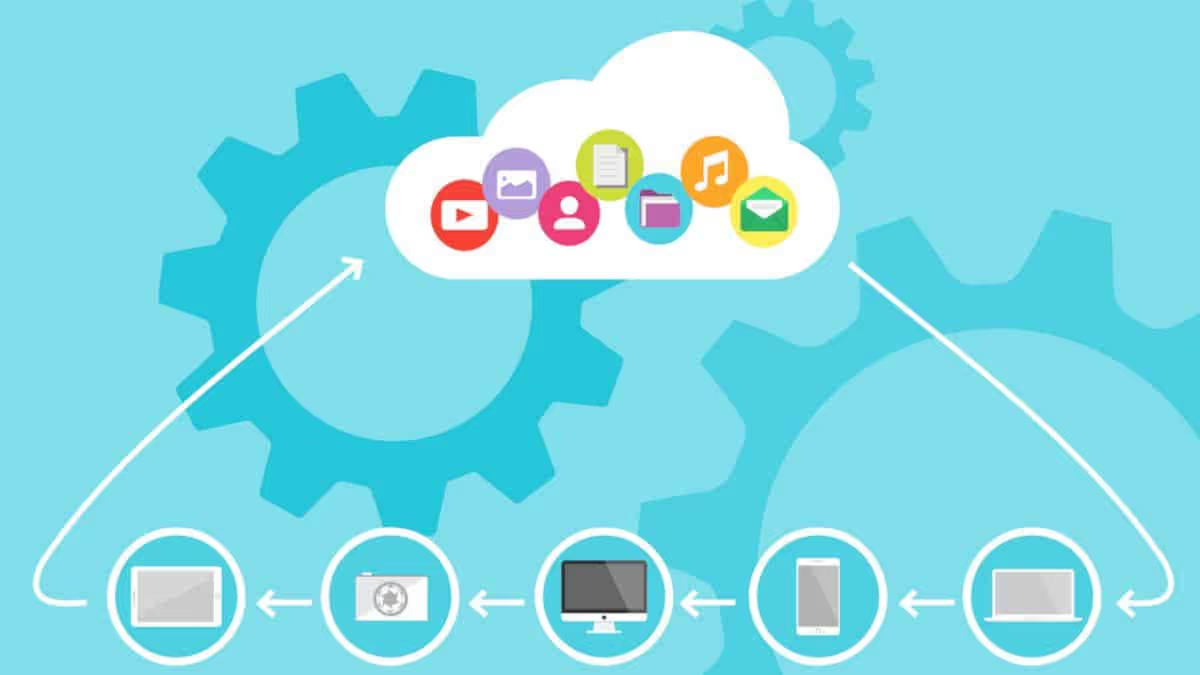
Let's start with software that allows file sharing. They are used by teams to store documents, share them and collaborate in real time. They offer relevant functionalities such as adding comments or managing access rights. Thanks to them, workspaces can move to the cloud and all collaborators, wherever they are, can access work documents.
Project management tools
Then we have project management software. An essential sharing tool for any project manager, they are used to access an overview of the tasks to be carried out, monitor deadlines and manage the progress of the project via a dashboard, which is often user-friendly.
Real-time communication platforms
To encourage collaboration, it is essential to have instant messaging. Thanks to the latter, employees can exchange information and organize meetings on the fly. Therefore, this software is very useful for maintaining a dynamic of collaboration between members, even if they are geographically distant.
Collaborative design tools
Some departments need to design products or services and collaborate on their documents in real time. Product design, the creation of wireframes or the development of mind maps are part of this category of tools. Leveraging collective intelligence, A design tool allows teams to collaborate fluidly.
Collaborative suite
Finally, we have the collaborative suite. This term refers to an online platform specially designed to simplify collaboration. It integrates all the collaborative functionalities necessary for team productivity.. Thus, within a single tool, we find messaging, document transfer, screen sharing or even task management.
How does collaborative technology improve productivity?
Taking advantage of these collaborative technologies makes it possible to adapt to new working methods such as the agile approach or teleworking. Employees who adopt these software have the opportunity to collaborate better and become more efficient. This is illustrated in particular by three key advantages:
- Facilitating communication: Exchange is at the heart of team collaboration. For this reason, collaborative tools are important to allow all employees to send or receive messages in seconds. Sharing information is then easier and team cohesion is strengthened.
- Improving project management: A collaborative platform that centralizes all the functionalities necessary for a project is ideal for saving time and money. Within a single tool, employees can work together, organize meetings and carry out the tasks assigned to them.
- Stimulation of creativity: Collaborative design tools, video conferences or the organization of brainstorming sessions are all ways to encourage innovation and creativity within the group.
The challenges associated with collaborative technologies
While collaborative technologies are perfect for encouraging group work and creating a form of emulation, they present depending on the challenges you need to respond to.
Security and privacy issues
Most of the solutions we've mentioned rely on the use of the cloud. For this reason, this raises the question of corporate data security. To address this strategic issue, businesses must carefully select the tools that enable collaboration.
In addition, platforms must be certified and implement appropriate security protocols. Let's add that it is recommended to store data in a data center based in France.
Accessibility issues
One of the strengths of these tools is to adapt to modern working methods such as teleworking. They make it possible to develop collaboration by offering solutions quickly accessible in a few minutes via the internet.
However, in order to use them effectively, it is necessary to benefit from a stable connection and have the necessary technological skills to take advantage of it. In particular, the company must be careful not to create a digital divide between new talents joining the company and older employees, who are less proficient in digital tools.
Challenges in adopting and training new technologies
These questions lead us to the question of the adoption of collaborative technologies. You can in fact being confronted with reticence from some employees. It is therefore very important to present the advantages of this new approach, which allows fruitful collaboration between peers. The organization of training courses adapted to different skill levels can be a very relevant response to this challenge.
An essential element in the business world today
It is obvious that you can't ignore collaborative technologies. Inexpensive, easily deployable and with numerous advantages, they are used to facilitate communication, increase productivity and improve employee engagement. These collaborative solutions will become omnipresent in businesses in the near future.
For this reason, we recommend that you start Deploy a collaborative suite today. To overcome reticence, be an educator and take advantage of the platform's tutorials and documentation to train your employees in these new uses.
Once they get used to these tools, they will become more autonomous, will be able to automate tedious tasks and will have access to remote work. Therefore, beyond increasing productivity for the company, It is also a way to significantly increase the well-being of employees within your company and to retain them for the long term.