SaaS vs on-premise software: what should you choose for your projects?

Collaborative platforms, customer relationship managers, communication tools, etc., today, when you want to acquire new software, regardless of its function, you generally have the choice between two solutions: SaaS or on-premise hosting.
What are the differences between these two types of accommodation? What are the pros and cons? A short summary to help you make the right choice for your business.
SaaS vs on-premise software: what is it?
SaaS means software as a service, or software as a service in French. The software you use is not installed on your company computers, but it is relocated and hosted by the publisher. This means that you are no longer buying a license, but you are subscribing to an all-inclusive service over a given period of time. Thus, you access your software through an Internet connection and you benefit from all its functionalities, the hosting and storage of your data, maintenance and support by paying a monthly subscription to the publisher or the host.
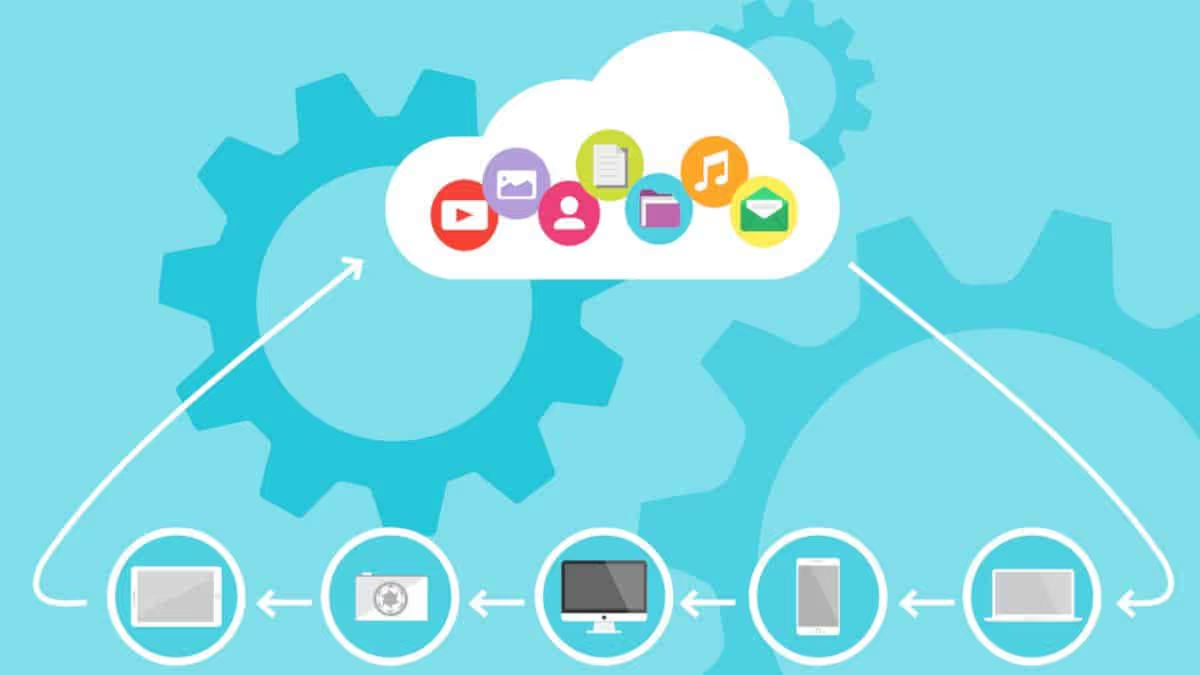
Having become very popular in recent years, this service is part of cloud computing or cloud computing. In fact, it is the same principle as long-term car rental (or leasing).
Conversely, a on-premise software (“on site” in French) is the traditional version of the software that you install on your company's servers or computers. In this case, you buy the license of use permanently from the publisher: the software is yours for an unlimited period of time.
Learn the pros and cons of both solutions to help you make a better choice.
The benefits of each mode
Peace of mind with SaaS mode.
- Rapidity : you save time since you do not need to install the software on all computers or servers in your company. In addition, as soon as you subscribe to your subscription, the software is immediately operational and ready to be used.
- Accessibility : you can use the software from any device, as long as it is connected to the Internet. You can therefore access your data everywhere, all the time since it is stored online. And you don't have to be equipped with newer computers for the software to work.
- All inclusive service : thanks to corrective and progressive maintenance, the service provider takes full care of the maintenance, updates and performance of the software. So you automatically have the latest version on your workstations. You save time, money (no need to use an external service provider) and you can focus on your core business.
- security : today, data security is a priority. By choosing SaaS software and by trusting a provider like Wimi which is committed to maintaining the confidentiality, security and sovereignty of your data, you have the guarantee that it is backed up, encrypted and hosted in highly secure data centers located in France, therefore out of reach of Cloud Act.
- Support and training : with your subscription, you generally benefit from a support service in case of problems, malfunctions or if you have questions regarding the use of the software. And sometimes, the provider can even offer you training.
Full control with on-premise mode.
- Autonomy : since you are acquiring the software, it is yours and everything is centralized in your company. You therefore do not depend on a service provider to whom you have to pay a monthly or annual subscription. You can customize and configure the software as you want, so that it best meets your needs.
- Accessibility : you do not need an Internet connection to access the software or your data since it is installed directly on your network or on your computers. So if there's a problem with the Internet, you and your teams can always keep working.
- Location and confidentiality of your data : your data is located on your servers, and it is therefore you who are responsible for their security and confidentiality. For some businesses, this criterion is imperative.
- Depreciation : you pay the price of the software all at once and it is yours indefinitely. Generally, the software is managed by your IT department. If you do not have this competence in-house, you may only be responsible for the annual maintenance costs. In the long term, the on-premise solution is more economical.
The disadvantages of each mode
The disadvantages of SaaS mode
However, choosing software in SaaS mode has some drawbacks.
- security : you entrust the storage and security of your data to a third party. The confidentiality and protection of your data are therefore no longer under your control. Even if the provider offers you the best guarantees in terms of data security and sovereignty, no organization is really safe from a cyber attack. Access management is also a delicate issue, especially when it comes to terminating the access of a former employee.
- Internet connection : you always need a powerful and fast Internet connection. Even if some providers offer offline mode, you will need to be connected to the Internet to synchronize your data.
- Breakdown or bankruptcy of the service provider : since the software does not belong to you and is not hosted on your servers, you could have problems working or recovering your data in the event of a system failure or the provider's bankruptcy.
The disadvantages of on-premise mode
Like SaaS, on-premise solutions have their drawbacks.
- Obsolescence : in the long term, the software you have acquired could become obsolete, and you will then have to acquire a new one.
- Hardware : installing and using software directly on your computers requires your equipment to be recent enough to technically support the software without crashing or lagging each time you launch it.
- Cost: For some software, you will have to pay an operating license for each computer on which you install it. While some updates can be done for free, enhancements, bug fixes, and new releases may incur additional costs.
- Formation : it is sometimes necessary to pay for training to your employees so that they learn how to use the software correctly, which also represents additional costs.
- Saturation : during lockdown and with teleworking, on-premise structures worked via corporate virtual private networks (VPNs) which exploded because they were not sized to support such a significant load, causing access problems.
To conclude
Between SaaS and on-premise, there is no ideal solution. The choice is subjective and depends essentially on the culture and specificities of your business. To make your choice, take into account your needs as well as the financial aspect, use and protection of your data.