GED: everything you need to know about electronic document management
In business, certain functions require the processing of a large quantity of documents on a daily basis. Invoices, orders, various letters, contracts, pay slips, pay slips, vacation requests, expense reports, etc., whether in paper or digital format, these documents must be created, processed, distributed to the people concerned, distributed to the people concerned, stored, and then archived.
Sometimes a document gets lost. You waste precious time looking for it, only to end up recreating it because you were not able to find it. While you and your employees you take care of the management Of all these documents, you cannot devote yourself to doing your real job and you are losing productivity. According toInformation and Management Association (AIM), an employee spends an average of 7:30 hours per week looking for information (paper or digital) without finding it.
Today, you want to set up a system to facilitate the processing of documents, and to ensure that each employee of the company can quickly find the document they need. It's time to discover electronic document management (EDM).
What is electronic document management?
As its name suggests, electronic document management or EDM refers to a computerized system that makes it possible to manage all the documents that circulate within a company. EDM is a collaborative process that takes care of the complete management of documents as well as the prioritization, storage, distribution and archiving.
The term GED is also used to refer to the tools necessary for the management of this documentary content. In English, GED is DMS for document management system.
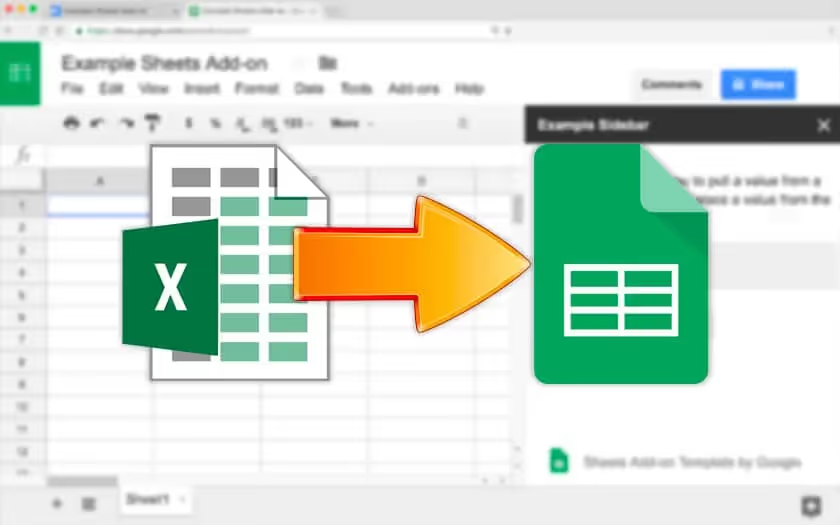
All types of documents can be stored on EDM software: paper documents, e-mails, Word, Excel or PowerPoint files, PDFs, images, etc.
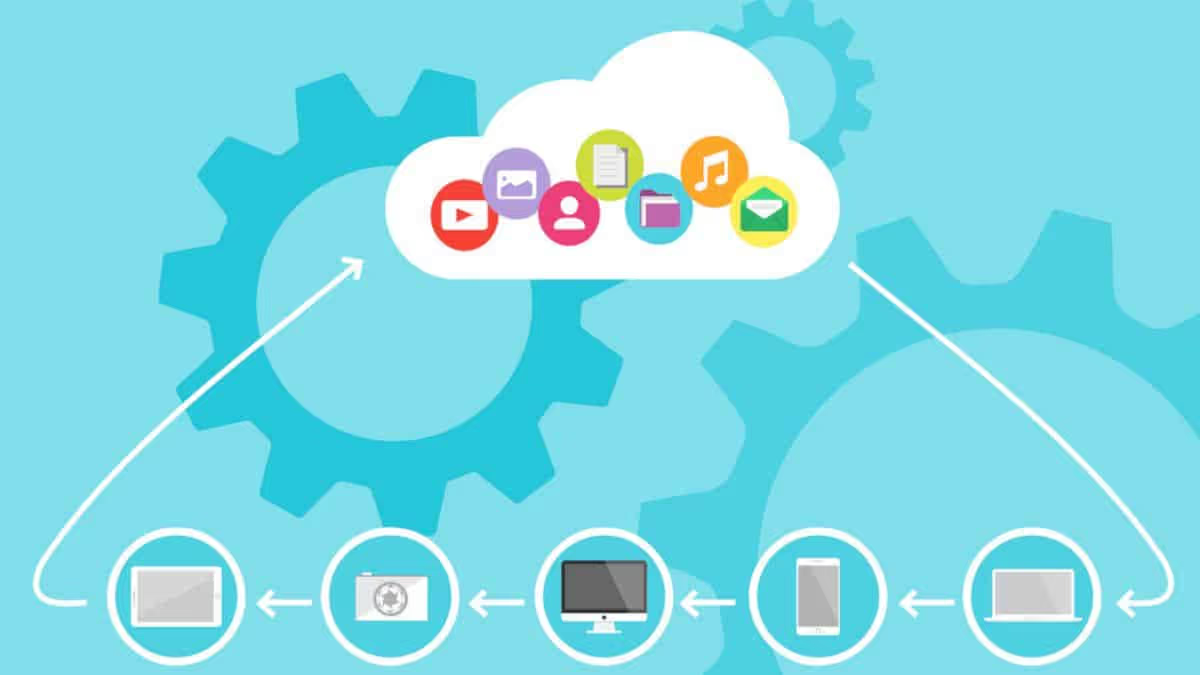
Your employees can easily and quickly find all the documents classified in the EDM thanks to a search engine. They can process and validate documents digitally, and share them with members of their team at any time, anywhere and from any device (computer, tablet or smartphone).
Electronic document management is the essential tool for digital transformation.
The advantages of EDM
In the digital age, all organizations should be equipped with EDM software because the use of this system greatly improves the organization of work internally and offers multiple advantages.
Centralization of information
All documents are available in a single and centralized space. This simplifies their access by all employees. Paper documents have been scanned and archived, so they are easier to find.
Time saver
You no longer waste time looking for a paper document that is untidy or lost in your office, an attachment hidden in the back of your email, or a file stored in a bad folder on your computer. The GED is equipped with an indexing system and a search engine to quickly find the file you are looking for.
More efficiency
Finding the document you need quickly allows you to complete your task more quickly and therefore be more efficient.
Productivity gain
Since you no longer waste time looking for documents or recreating existing files, you can focus more on completing your missions. So you are more productive on a daily basis.
Ease of access
Your employees can easily access the documents they need to work at any time and wherever they are.
Enhanced collaboration
Since documents are accessible from everywhere, EDM promotes collaboration between hybrid teams, remote employees or employees who work in offices at the other end of the country or the world.
Reduction of errors
Most EDM software offers the possibility of modifying content as well as a version system. This ensures that you are always viewing the latest version of a document, which reduces the risk of making mistakes.
Securing data
All company documents are stored in a secure system, protected from cyberattacks, breakdowns, natural risks (floods, fire, etc.), etc. Only authorized users have access to them.
Reduced paper printing costs
You save on the costs of printing paper documents (purchase of paper and ink), the treatment of paper waste as well as postal costs.
The limits of GED
While the benefits of electronic document management are numerous, there are some limitations.
Investing in efficient equipment
Organizations need to process an ever increasing volume of data and information in a variety of formats. It is therefore essential to equip yourself with efficient EDM software and to choose an efficient storage method that does not affect the performance of your server and makes it possible to avoid failures. The purchase and maintenance of this type of tool have a cost that must be anticipated.
Adopting new ways of working
Opting for an EDM solution involves changing the way the entire company works. This requires in particular to set up training courses to learn how to use the tool correctly, to establish rules for filing documents, and possibly to launch a change management.
Anticipating security risks
The dematerialization of documents is not without risks. If an employee accidentally deletes a digital file, it will be lost forever. It is therefore recommended to use an electronic archiving system (SAE) that allows you to keep your digital documents securely and to strictly control their deletion. You must also protect your EDM against potential cyberattacks, in particular by setting up a cybersecurity strategy.
Thanks to EDM, your employees can easily and quickly access the documents they need, when they need them and securely.