Scrum Method: An Introductory Guide for Beginners
In project management, customer needs are rarely fixed. The agile approach brings together several methods that offer greater flexibility in project management by integrating the client throughout the implementation process. Thus, all his requests are taken into account in real time, which guarantees his satisfaction and the success of the project.
The Scrum method is part of the agile methodology.
Definition
The Scrum method offers a dynamic, participatory and empirical (i.e. based on experience) approach to project management. The involvement and active participation of the client are encouraged throughout the project. Scrum is widely used in IT development projects because customers have not always determined the set of features they want to incorporate into their software. The team must therefore be flexible in carrying out the project in order to integrate new functionalities as and when.
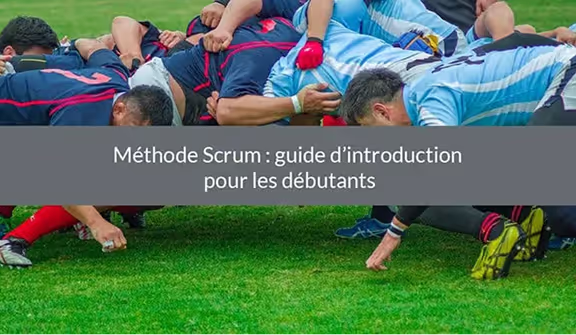
In English, scrum means scrum in reference to rugby union where scrum is an essential phase that allows the game to be restarted. In Scrum, scrum is a daily meeting during which the team takes stock of the progress of the project and what needs to be done during the day.
Origin of the Scrum method
The term “scrum” was first used in January 1986 in an article called The New New Product Development Game published in The Harvard Business Review by Hirotaka Takeuchi and Ikujiro Nonaka, two Japanese management researchers. The authors then use sports metaphors to illustrate their point, in particular by comparing one of the methods to rugby.
In the early 1990s, several companies put into practice methodologies based on the principles described by the two Japanese researchers. In 1995, Ken Schwaber and Jeff Sutherland jointly presented an article describing the Scrum method. They work together to enrich the method and co-write The Scrum Guide. Both also participated in the drafting of the agile manifesto in 2001.
How does it work?
Scrum follows specific rules and consists of several fundamental elements:
- Of roles,
- Of happenings,
- Of artifacts.
Roles
The Scrum method defines three main roles:
- The Product Owner : it is generally the customer. It carries the vision of the product to be achieved. He collaborates directly with the development team. Its role is to prioritize the functionalities to be developed or fixed, and to validate the completed functionalities. Finally, he is responsible for managing the product backlog.
- The development team : its role is to transform the needs defined by the Product Owner into operational and usable functionalities. The team is multidisciplinary and has all the skills necessary to carry out the project. It should ideally consist of 3 to 9 people, which makes it possible to optimize flexibility, creativity and productivity. There is no concept of hierarchy, all decisions are made together and the team chooses the best way to do their work themselves.
- The Scrum Master: it ensures that Scrum principles, rules, and values are well understood and applied. He acts as a coach for the development team and the Product Owner to help them maximize productivity. Its role is to facilitate dialogue between the various stakeholders in order to resolve possible conflicts. He is also the one who leads the meetings, and in particular the daily scrum meeting.
Events
The project is organized around development sprints (iterations) that generally last between one and four weeks. At the end of each sprint, a finished and usable version of the product is produced. A new sprint starts as soon as the previous one comes to an end. Each sprint is like a mini-project with an objective to achieve.
Several meetings take place during each sprint. Each of these meetings must respect a specific time:
- Sprint planning : before each sprint, we define the expected result at the end of the iteration and what are the tasks to be completed to achieve it.
- The daily scrum (or daily scrum): an essential and quick 15-minute meeting, it takes place every day, ideally in the morning, and allows you to take stock of the progress of the current sprint. During this meeting, each member of the team must answer these questions: what did you do yesterday? What are you planning to do today? Did you encounter any difficulties?
- The sprint review : at the end of the sprint, this meeting allows the team and stakeholders to take stock of the sprint and to validate whether the functionalities delivered meet the objectives set.
- The retrospective sprint : an internal team meeting that allows the team to identify what worked well and what did not work, and thus improve for the next sprint.
Artefacts
Scrum artifacts provide the team and stakeholders with key information that allows them to understand the product under development, planned tasks, and completed tasks.
- The product backlog
It is a prioritized list of all the tasks required to complete the project. This document is constantly evolving according to the needs of the client. It is the Product Owner who is responsible for it.
- The Sprint Backlog
This is the detailed plan for achieving the Sprint objective. It specifies all the tasks to be completed in the current sprint. It is continuously updated by the team for better visibility on sprint progress.
- The increment
This is all the completed elements of the current sprint, as well as those of the previous sprints. The increment should work and be usable.
To conclude
The Scrum method is very popular for developing mobile applications or websites. It allows intelligent work management and offers better visibility on the progress of the project, but it involves rigorous monitoring of the rules.