RACI Matrix: Definition of Project Management Responsibilities

You are launching a new project and the team is motivated. But quickly, chaos ensues. Who does what? Who validates what? Some tasks are forgotten and others are done in duplicate. Without using a suitable method, the confusion will quickly spread and the project will stagnate. Fortunately, there is a simple and effective solution to clarify everyone's roles and responsibilities: the RACI matrix. In this article, discover how to build a RACI matrix and exploit its potential to optimize the management of your projects.
What is the RACI matrix? Definition
The RACI method is also called the Responsibility Assignment Matrix (RAM). It is an easy-to-use management tool that takes the form of a table that distributes functions and responsibilities between the various actors in a project or activity.
RACI is an English acronym that stands for:
- A: Responsible or director, that is, the person who carries out the task.
- A: Accountable or approver, i.e. the person who supervises and approves the completion of the task.
- C: Consulted or consulted, that is, the person who advises.
- I: Informed or informed, that is, the person who needs to be informed.
In summary, the RACI method makes it possible to define who are the operational members of the project and their respective tasks, who is the sole decision-maker, who can be asked for advice, but also who must be informed of the progress of each task over time.
Why use the RACI method?
The RACI matrix gives the project manager an overview of resource allocation and workload distribution within the project. Thus, it ensures that all tasks are distributed fairly among all resources and prevents one employee from being overworked while another would be completely forgotten.
It is therefore a powerful tool for clarifying roles and responsibilities within a team or a project. It helps to avoid confusion, oversights and conflicts by clearly defining who does what.
How does the role breakdown table work?
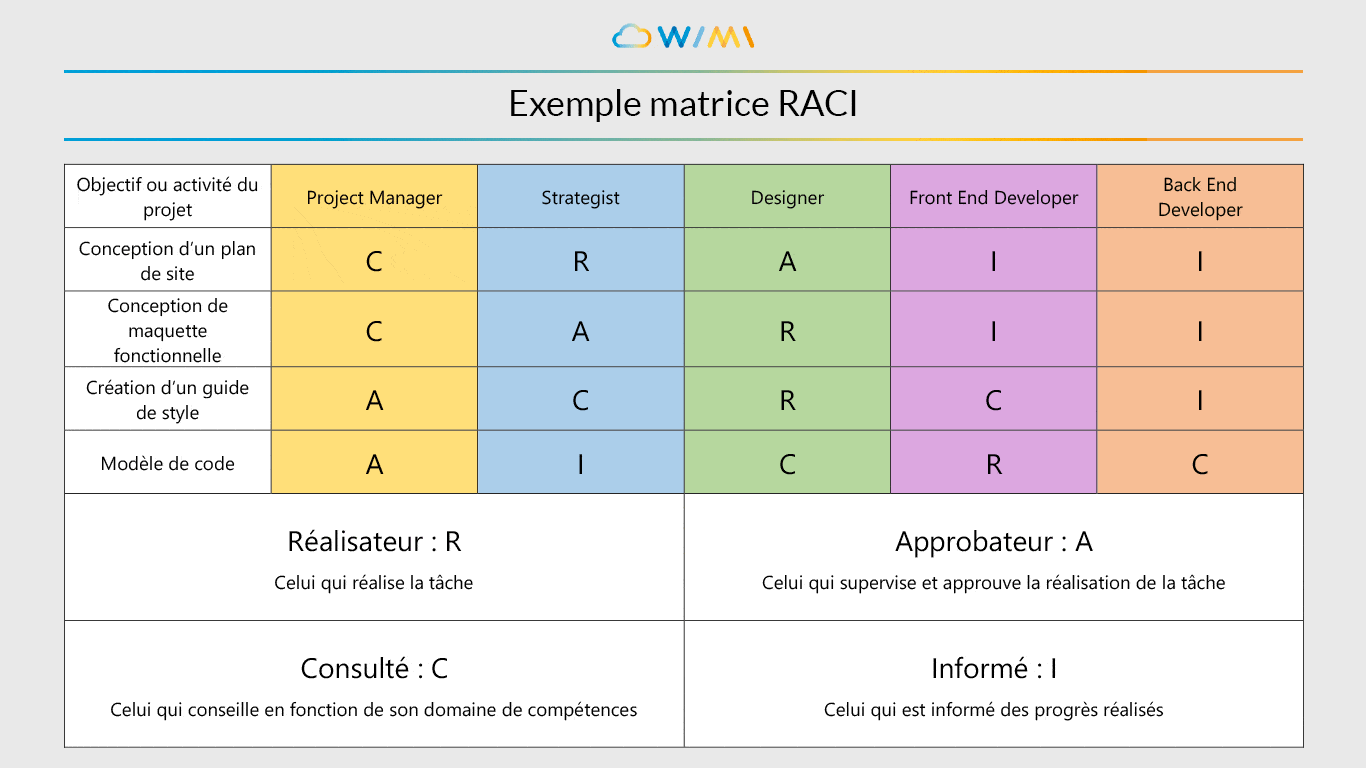
In the table, each task is assigned to a single responsible person (A), but multiple people can be responsible for completing it (R). All actors in the project know who to contact in case of doubts or questions (C) and who to inform (I) concerning the progress of this or that task.
The RACI matrix is constructed in the form of a double-entry array. Online, we find the various tasks, actions, milestones, steps and deliverables to be carried out. The various stakeholders are indicated in columns (it is not necessarily a question of naming the members of the team, but rather of mentioning the functions, services or trades required). Finally, in each cell, the letters R, A, C, I determine the roles and responsibilities of each cell.
What are the rules to follow when using the RACI matrix?
There should be at least one R for each task. They are the ones in charge of completing the task.
The A approves and validates the task for which he is responsible and ensures its progress within the deadlines. He is responsible for the organization of the work and the results produced by the R (s). So, if the R's fall behind schedule or don't meet the goals set, the A is responsible for the situation. There is only one A for each task, but the A can also have the role of an R.
The C (s) (individuals or groups) have expertise in a specific field. They may be asked by the A and/or the R to give their opinion or advice, however they have no authority over the task. It is the A who decides whether or not to apply the opinion of the C.
I do not intervene, but they can be impacted directly or indirectly by the project (users, suppliers, peripheral project managers, etc.). They must therefore be informed of the evolution of the project and of important decisions.
RACI matrix example
Below is a complete example of a RACI matrix that allows you to better visualize the principles of the method.
What are the potential challenges when implementing the RACI matrix?
The RACI matrix is a powerful tool for clarifying roles and responsibilities, but implementing it can present some challenges.
In particular, because of resistance to change, employees may be reluctant to adopt new ways of working. It is therefore important to communicate the benefits of the RACI matrix well and to involve teams in the implementation process to minimize resistance.
Also note that if roles and responsibilities are not precisely defined, the RACI matrix can create more confusion than it solves. So you need to spend time clearly defining each role and making sure everyone understands its implications.
For the RACI matrix to be used effectively, teams need to be trained in its use and receive adequate support. A lack of training can in fact lead to a poor understanding of the matrix and to ineffective use.
Advantages and limitations of the RACI table
The RACI matrix has a number of advantages. The method clearly defines who does what, thus avoiding confusion and conflicts. Each task has a clearly identified manager and authority, which promotes accountability.
In addition, this approach facilitates communication by clarifying who should be consulted while improving coordination and avoiding duplication.
However, the RACI matrix is only a tool for allocating resources and not for defining project tasks. For it to be effective, you must determine in advance the various stages of your project and all the tasks and activities necessary to carry it out. It also does not take into account the financial aspect of the project (such as the costs associated with completing a task).
Second, as a project manager, you need to ensure that roles and responsibilities are allocated in a balanced manner between all actors in the project in order to avoid overwork or under-workload between different team members.
Let's add that the RACI matrix is not an automated system. You should therefore update it regularly in case of changes in tasks or turnover within the team.
What task management tools can help create a RACI matrix?
WIMI, as an all-in-one collaborative platform, offers several functionalities that can facilitate the creation and management of RACI matrices. This platform allows you to create tasks, assign them to team members, set deadlines, and track their progress. You can use these tasks as the basis for your RACI matrix.
Using this tool, you can plan and track project progress with Gantt charts, which can help you identify dependencies between tasks and clarify responsibilities.
WIMI also facilitates communication and collaboration between team members, which is essential for creating and maintaining a RACI matrix.
By combining all the functionalities of WIMI, it is thus possible to create a clear and concise RACI matrix, assign roles and responsibilities transparently, monitor the progress of tasks, facilitate communication and keep the RACI matrix up to date throughout the project.