Plan a project effectively using the critical path
Have you ever started a project with a clear vision, only to be overwhelmed and lost during the process? Depending on the complexity of the project, it can be difficult to keep track of all the tasks that need to be completed and the order in which they need to be addressed.
Project planning is a crucial aspect of project management. Without proper planning, projects can easily fall through the cracks, leading to missed deadlines, increased costs, and even failure. That's where the critical path method comes in.
The critical path method is a project management technique used to identify the most important tasks in a project and determine the optimal sequence for completing them. By using this method, project managers can effectively plan a project and ensure that it stays on track throughout its life cycle. In this article, we'll explore the critical path method in more detail and provide tips on how you can use it to successfully plan your next project.
What is the critical path?
The critical path is an ideal management method to optimize your actions. Indeed, it makes it possible to accurately determine the key steps as well as the dependencies between the tasks. By doing so, it becomes possible to identify the path to complete the project as soon as possible.
Typically used when designing a Gantt chart or a PERT chart, the critical path makes it possible to identify tasks and task sequences that have no margin.
By inventorying the hardest tasks or the most delicate sentences of the project, project managers thus have the ability to better plan the completion of these tasks. Thanks to this preparation in advance of difficulties, they can avoid delays, but also overruns of the financial resources allocated.
What are the advantages of the critical path?
To ensure the management and monitoring of projects, the critical path is very relevant. This is because it has undeniable advantages for the performance of your team.
Visualization of tasks
With the right project management software, you can take advantage of the critical path. You will then visualize with great clarity all the tasks of the project and their dependencies. This is an important point in order to access a global vision of the project and to manage teams more effectively throughout the critical stages.
Scheduling tasks
Once critical tasks have been identified, it is possible to monitor the progress of the tasks in an optimal manner. This allows you to better manage risks and ensure good project planning.
Determining deadlines
By analysing the critical path, project managers have the opportunity from the start of a project to estimate the minimum duration of the project. In addition, by quickly identifying difficulties, it becomes possible to act primarily on critical tasks in an attempt to reduce project deadlines.
Respect of deadlines
The logical consequence of using the critical path is the respect of deadlines imposed by customers. Project progress is smooth as long as critical tasks are managed scrupulously.
Resource Management
This planning method is ideal for allocating resources effectively. By knowing the duration of each task as well as its difficulty, it becomes possible to allocate the necessary human and financial resources and avoid any overload of work.
How do you determine the critical path?
To manage your projects more effectively and reduce their total duration, it is necessary to implement best practices to determine the critical path. Five steps are essential to monitor the project using this method.
List all the tasks of the project
Above all, it is essential to take stock of all the stages and tasks that make up the project. During this phase, don't forget to list the tasks, but also the sub-tasks. The more meticulously this preparatory stage is carried out, the more relevant will be the study of the critical path.
Determine dependencies
The order of tasks is critical when it comes to planning projects. Indeed, some tasks can only start until other tasks are fully finalized. That's why you need to determine dependencies between tasks. The latter can in particular be highlighted when creating a network diagram.
Calculate the duration of each task
Then, the project manager, assisted by team members if necessary, must estimate the duration of each of the tasks to be carried out. It is possible to rely on previous projects and/or on the experience of each collaborator in carrying out a given task.
Identify critical tasks
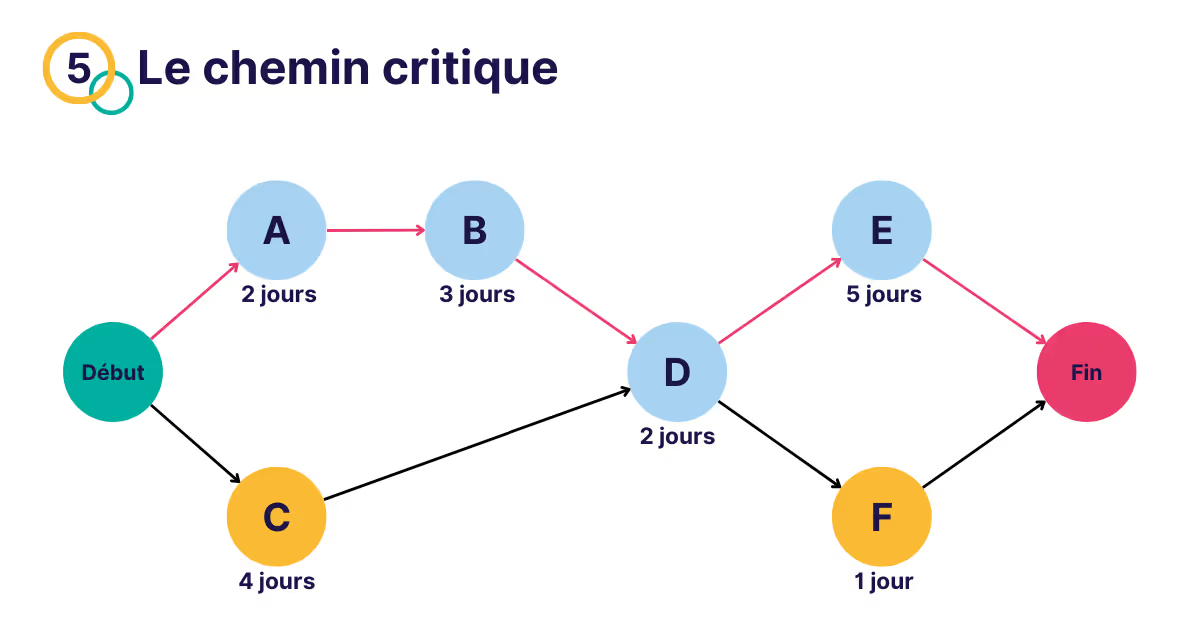
At this stage, it is possible to access a relatively fine vision of the project to be carried out. So now is the time to determine which tasks have the most impact on the total duration of the project. Concretely, for each possible path that you identify on the network of tasks to be carried out, you must calculate its theoretical length. Once this step is finalized, the longest path is the critical path.
Manage critical tasks
Once the critical path and critical tasks are identified and taken into account, they should be integrated into the project schedule. To avoid deadlines being missed, it is necessary to ensure optimal time management for each of these key steps. If necessary, the project manager can then allocate additional resources to control the duration of the projects.
A project management tool: ideal for identifying the critical path
To save time and optimize the work of your team, the best thing is to use planning and collaborative work software. Indeed, the best management software makes it possible to centralize all the needs of the team within a single tool in SaaS mode. It then becomes possible to quickly create a Gantt chart, a PERT chart and to identify the critical path for each project. In particular, this is ideal for optimizing resources, meeting deadlines and improving end customer satisfaction.