Agile working: an innovative and adaptive way of working
The modern workplace is constantly evolving and organizations need to be prepared for change. One approach that has helped many businesses become more productive is agile working, a flexible and adaptable way of working that focuses on collaboration and communication.
The idea of agile working originated in the software development industry in Japan in the 1950s, but it has become an increasingly popular concept in today's workplace. It's about bringing teams together to complete projects and tasks quickly and effectively using teamwork, innovation, collaboration, communication, and creativity.
Agile working isn't just a trending term; it's been shown to provide real results for businesses looking to improve productivity in the short and long term. In this article, we'll look at how this innovative approach can help your organization improve efficiency, adapt to change, and ultimately achieve its goals.
The principles of agile working
The agile methodology is based on a specific philosophy. Indeed, numerous principles frame this approach and make it possible to better understand it.
We therefore have four agile values:
- Individuals and their interactions, rather than processes and tools;
- Operational solutions are more important than comprehensive documentation;
- Collaboration with the customer, rather than contract negotiations;
- Adapting to change is better than sticking to a plan.
To complete this agile model, there are 12 principles that are found in the agile manifesto. These include the priority given to customer satisfaction, the importance of the regular delivery of versions and simplification.
In summary, we can say that agile approaches focus on collective intelligence, resilience, and practicality.
The benefits of agile working
If you choose to implement agile methods within your business, you will certainly reap the benefits. Indeed, agile projects make it possible to obtain relevant assets.
Responsiveness to change
By being open to upheavals and the unexpected, your employees become much more resilient. They are less anxious and respond better to change. This agility also extends to the company itself, which is becoming more resistant to crises.
Increased productivity through effective communication
Since the agile approach is based above all on continuous exchanges, a more agile company is also a more communicative company. However, these qualitative and sustained exchanges promote an increase in productivity, in particular through the effective sharing of information.
A strengthened team culture
The collaboration of agile projects makes it possible to strengthen the links between employees. They learn to communicate more directly, have more self-confidence and are in a position to take on more ambitious challenges.
An improvement in satisfaction
Finally, this approach based on continuous improvement makes it possible to increase the quality of products and services. So customers are more satisfied. Moreover, this satisfaction also applies to teams who are more involved and more motivated by the projects they take on.
The most common agile ways of working
If you want to implement an iterative approach and rapid developments, an agile process is ideal. Different methodologies exist and respond to different problems. So there's really no one approach that's better than another. The main thing is above all to opt for a strategy adapted to your needs and the specificities of your project.
The Scrum method
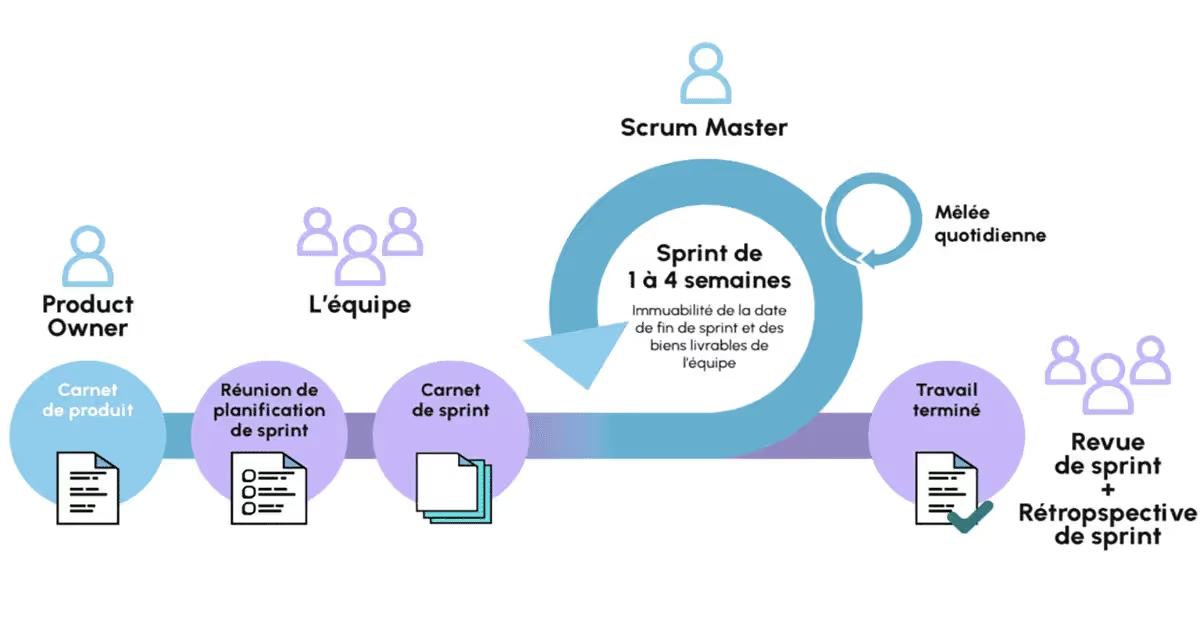
Scrum is a popular project management methodology that uses short, iterative sprints to solve complex problems. Its main features are weekly sprints, a cross-functional team structure, and regular meetings with stakeholders.
Scrum focuses on frequent feedback from stakeholders and team members to ensure the highest quality product. It also requires teamwork, collaboration, and communication between all team members to ensure that each part of the project is progressing steadily toward its goal within the expected timeframe.
The kanban method
The Kanban method is an agile strategy aimed at improving the flow of work in business processes. In Kanban, teams use visual maps and boards to represent each stage of a project. As each task moves from one stage to the next, everyone involved gets signals and updates about the changes.
By using this method, teams can visualize their workflow and manage tasks more effectively, leading to increased productivity and better collaboration between team members.
Hybrid methods
The hybrid approach combines different project management methods. The idea is to generally combine an agile method and a classical method such as waterfall methodology. In this way, the team can theoretically benefit from the advantages of each method.
There is even a combination of agile practices: the scrumban method. Its objective is to combine the scalability of the Scrum method with the management of flows of the Kanban method.
The conditions for the successful deployment of the agile method
While the agile development cycle is not only reserved for IT projects, there are, however, conditions for success to become agile. By following some best practices, you maximize your chances of taking full advantage of these fluid and efficient approaches.
A clear vision of the company's goals
Above all, it is obvious that you need to start your projects on a solid basis. The first step is therefore to set clear and realistic goals for your company and your project teams. Indeed, there must be a strong correlation between the characteristics of agile methods and your particular needs.
Effective communication within the team
Then, all employees must be willing to work together. Efficiency depends in particular on quality communication. The information must flow smoothly and everyone must be involved in the method you have selected. Of course, it is highly recommended to recruit experienced profiles such as a product owner or a scrum master to form a complete and efficient agile team.
A corporate culture adapted to agile working
There is no point in opting for an agile method if the corporate culture does not follow. Decompartmentalize departments, opt for a horizontal hierarchy, and encourage feedback to improve processes. The entire company must carry out its agile revolution if you really want to improve performance.
Project management tools
Finally, you must acquire tools adapted to collaborative work. Indeed, your collaborators must be able to communicate, send files, launch video meetings on the fly or follow the evolution of the project. The ideal is to centralize all processes and information via an online platform specialized in teamwork. This will save you valuable time and unify practices while maximizing team spirit.