What is the public cloud?
Cloud
5 min
Posted on
4/2/2026


If cloud solutions often prove to be essential for the productivity and growth of a business, it can be tricky to find your way around. Indeed, this field of cloud computing generally brings with it a lot of technical terms. The public cloud is one of them. In order to help you to clearly identify the characteristics of the public cloud, its advantages and the differences between the types of cloud, we offer you this dedicated article.
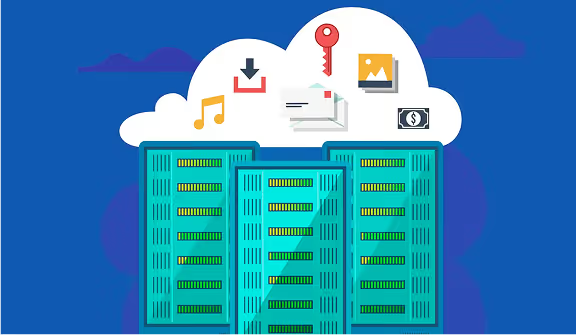
It is very likely that you have already become aware of The definition of the cloud in general. However, the term public cloud may still seem a bit nebulous to you. Know that public cloud simply refers to a cloud computing model where computer resources are made available to users via an internet connection.
The customer thus does not worry about the infrastructure necessary for the cloud to function. All he has to do is connect to an online application or a platform in order to create a corporate document sharing in a few seconds.
To help you better understand what a public cloud is, here are some of its characteristics:
To ensure its functioning, the public cloud is built around three essential and closely linked layers: infrastructure, platform, and software.
The first layer, infrastructure means the physical elements that allow the cloud environment to function. For example, it integrates the servers, information storage hardware, and network equipment that make up the public cloud structure.
The second layer is the one that will provide basic services, essential to the whole. Within this layer, we find in particular operating systems, databases, but also development tools.
Finally, the last layer is the software layer. It is about all the solutions of cloud storage, the applications and services that are hosted in the cloud and usable by the end customer. This is the case with email services, customer relationship management (CRM) software, or enterprise resource planning (ERP) tools.
Let's add that you may encounter different types of public clouds. In fact, each model meets a specific user need. Examples include SaaS (Software-as-a-Service), IaaS (Infrastructure-as-a-Service), or FaaS (Function-as-a-Service) approaches.
Depending on its specific problems, an organization may prefer this or that type of cloud. However, it is true that The public cloud has a number of advantages. These are all factors in favor of selecting such an approach to the cloud.
Reasons to opt for a public cloud include:
The public cloud refers to an approach where the infrastructure is owned and managed by an external service provider.
On the contrary, the private cloud Is a cloud model where the hardware and data are operated exclusively by one user. The latter then maintains greater control over the entire cloud environment and data. However, security requirements are borne by the user and the cost in terms of human, financial and technological resources is high.
The public cloud is entirely off-site. It is a external supplier that has the hardware necessary for the cloud environment And he has the responsibility for its management.
In the case of hybrid cloud, the cloud environment integrates public cloud and private cloud elements. In other words, the resources are deployed on a private site as well as a service provider's data center. This approach is interesting because it offers significant flexibility and gives users more control.