The benefits of cloud solutions for modern businesses
Cloud
5 min
Posted on
4/2/2026

One of the most important challenges for businesses is to streamline operations, improve efficiency, and optimize costs. To achieve all of these goals, cloud solutions are an ideal solution. Revolutionizing the way many businesses operate, cloud computing provides online services, computing power, or storage solutions on demand.
Responding to the challenges of remote work, agile methods or the rise of AI, cloud solutions allow you to increase productivity, improve the scalability of your processes while significantly reducing associated costs. Let's immediately discover the advantages, disadvantages and uses of cloud solutions.
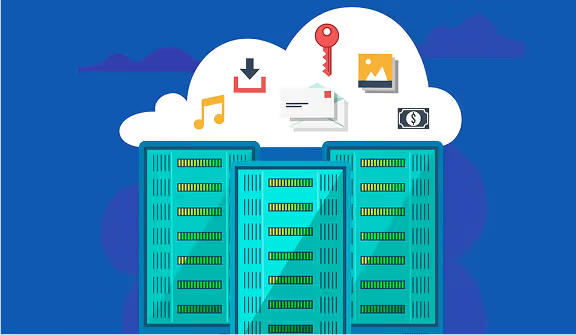
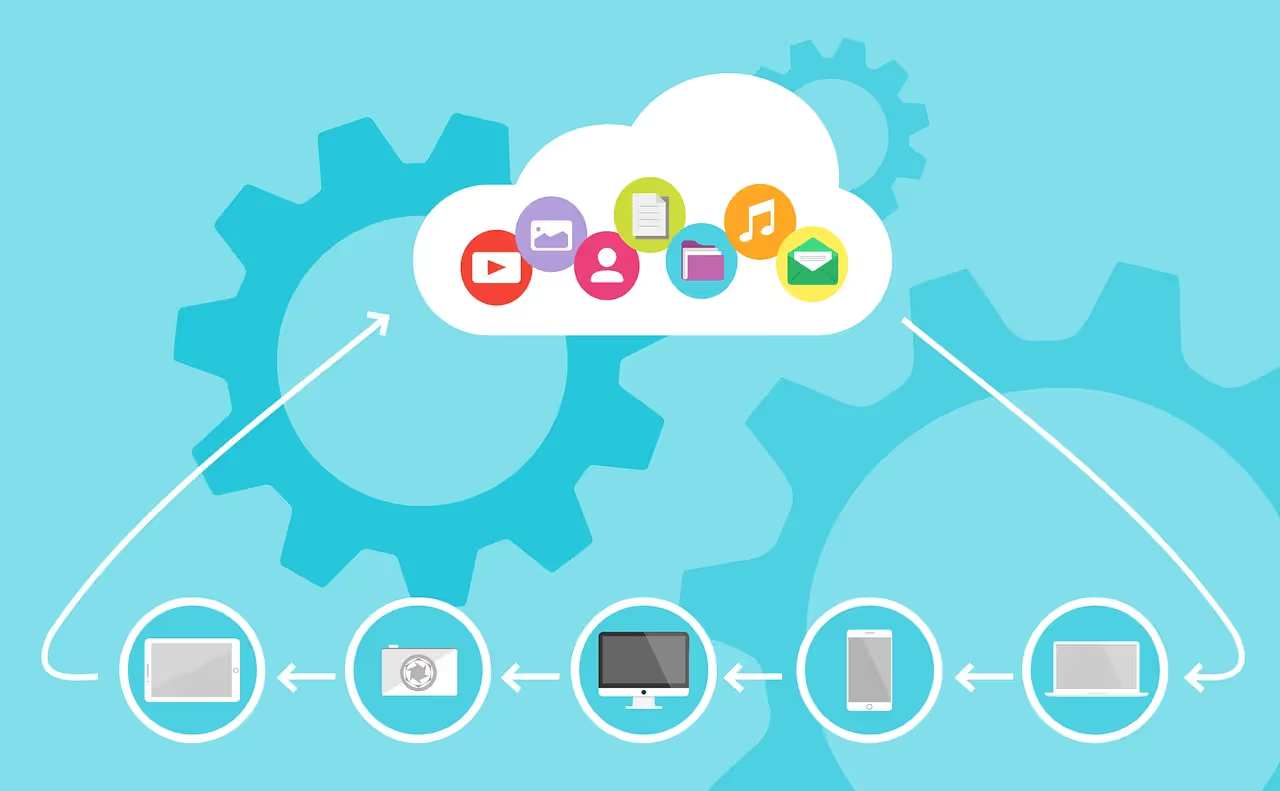
Cloud computing, or cloud computing in French, is a technology that allows access to computing resources (such as servers, storage, databases, development tools, applications, and services) via the Internet, without the need to physically own these resources.
A cloud solution represents a set of IT solutions that work thanks to the Internet network. These can be computer servers, a storage service, databases, web applications or even calculations carried out online.
To access cloud computing, all you need is a simple internet connection. Thus, many companies are choosing a cloud solution, because such an approach combines numerous advantages.
Used by small businesses as well as large businesses, cloud computing offers concrete applications for various sectors.
Cloud services are mainly organized into three main categories. Each of them meets different needs and goals. However, many businesses use multiple types of cloud services jointly in order to improve their performance.
This first category includes all physical computing resources such as servers, storage, and networks from a data center. Using the IaaS cloud is ideal for businesses that do not want or cannot deploy a large IT infrastructure. By outsourcing this need, businesses save time and money.
Used by development teams, PaaS provide quick access to a platform and a dedicated development environment. Developers then have access to all the resources and functionalities necessary to develop and design applications or services on the Internet.
Very common, software-as-a-service or software as a service refers to an application managed via the cloud and accessible to users via the Internet. These essential tools can be video on demand services as well as software for businesses. They require no maintenance and are accessible in a few moments via cloud technology.
While the advantages of a cloud computing solution are numerous, it is essential to consider their disadvantages. This will allow you to determine if the use of cloud computing services actually meets your needs.
Cloud computing has 4 advantages:
While the cloud is an opportunity for many businesses, it is however necessary to solve a few challenges that may arise. Here are the main disadvantages of cloud computing
There are 3 deployment models for cloud computing:
Les cloud solutions offer a wide variety of use cases. Infrastructure and services can be moved to the cloud to save time, reduce costs, and increase productivity.
One of the most interesting uses of the cloud for your business is undoubtedly a collaborative solution. This type of cloud platform centralizes a set of essential features that help teams work better together. Collaborative work thus takes on a whole new dimension by combining messaging, a file storage and exchange system or even videoconferencing software within a single tool.
Accessible anytime and anywhere, a cloud collaboration solution allows you to meet many of today's challenges and improve the cohesion and commitment of employees.